
The Ultimate Guide to Living Well for Less
In a world that constantly screams “buy more,” “upgrade now,” and “you deserve it,” choosing to live frugally is a quiet act of rebellion. Many people mistake frugality for deprivation. They imagine dusty rooms, thin soup, and never having any fun.
The truth is the exact opposite.
Frugal living is not about being cheap; it’s about being resourceful. it is the art of intentional spending—cutting costs ruthlessly on the things that don’t matter so you can spend extravagantly on the things that do. It is the secret weapon of the wealthy and the foundation of financial freedom.
In this guide, we will transform your relationship with money. You will learn how to reduce your expenses by thousands of dollars a year, not through painful sacrifice, but through smarter, more intentional habits. Let’s dive into the world of living well for less.
Living frugally helps you reach your financial goals faster.
If you haven’t already, read our guide on
Financial Goal Setting.
You should also review
Budgeting Strategies That Work to manage your spending better.
Table of Contents
- What is Frugal Living? (The Mindset Shift)
- The Financial and Psychological Effects of Frugality
- The “Big Three” Cost Cutters: Housing, Transport, and Food
- Step-by-Step Frugal Lifestyle Transformation
- Frugal Living Charts: Small Changes, Big Results
- Smart Shopping and Consumer Habits
- Frugal Entertainment: Having Fun for Zero Dollars
- Common Frugal Living Mistakes to Avoid
- Real-Life Instances of Frugal Success
- Frequently Asked Questions (FAQs)
- Conclusion
What is Frugal Living? (The Mindset Shift)
Frugality is defined as the quality of being economical with food or money. However, in modern personal finance, it is better described as Value-Based Spending.
A “cheap” person tries to spend the least amount of money regardless of quality. A “frugal” person looks for the best value. A frugal person might spend $100 on a pair of boots that lasts ten years rather than $20 on a pair that lasts six months.
The Pillar of Intentionality
The core of frugality is asking “Why?” before every purchase.
- Why am I buying this?
- Why does it cost this much?
- Why is there no cheaper alternative?
When you master the frugal mindset, you stop being a passive consumer and start being the CEO of your own life.
The Financial and Psychological Effects of Frugality
Adopting frugal habits creates a ripple effect throughout your entire life.
1. Rapid Wealth Accumulation
The most obvious effect is that you keep more of what you earn. Frugality acts as a massive “raise” that is completely tax-free. If you cut $500 from your monthly expenses, that is $6,000 a year added directly to your net worth.
2. Reduced Stress and Anxiety
Financial stress usually comes from living on the edge of your income. When you live frugally, you create a “buffer.” Knowing that you spend significantly less than you earn provides a sense of security that no luxury purchase can match.
3. Greater Appreciation for Quality
When you stop buying “junk” on impulse, you begin to appreciate high-quality items and experiences. You trade quantity for quality.
4. Environmental Impact
Frugality and sustainability go hand in hand. By consuming less, repairing more, and avoiding waste, you naturally reduce your carbon footprint.
The “Big Three” Cost Cutters
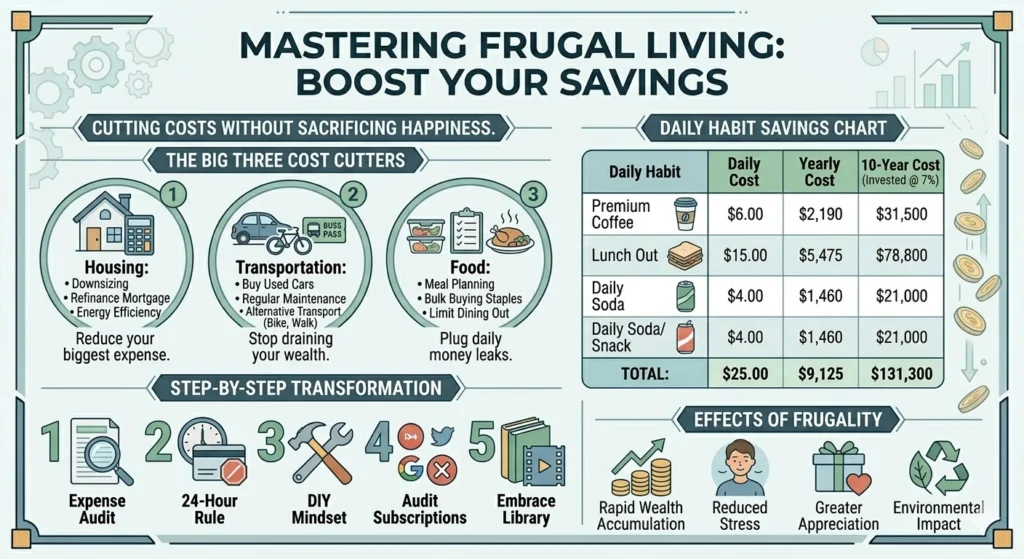
If you want to see massive results quickly, you must target the “Big Three”: Housing, Transportation, and Food. These usually account for 60-70% of the average household budget.
1. Housing
You don’t always need to move to save money, though “downsizing” is the most effective frugal housing move.
- Refinance: Lower your interest rate if possible.
- Energy Efficiency: Seal drafts, use LED bulbs, and install a programmable thermostat.
- House Hacking: Consider renting out a spare room or a basement to cover a portion of your mortgage or rent.
2. Transportation
Cars are often the biggest “wealth killers” due to depreciation, insurance, and fuel.
- Buy Used: Never buy a new car. A two-year-old car is often 30% cheaper.
- Maintenance: Regular oil changes prevent $3,000 engine failures.
- Alternative Transport: Bike, walk, or use public transit for short trips.
3. Food
This is the area where people “leak” the most money.
- Meal Planning: Never go to the store without a list.
- Bulk Buying: Buy staples (rice, beans, flour) in large quantities.
- Limit Dining Out: Treat restaurants as a rare luxury, not a Tuesday night habit.
Step-by-Step Frugal Lifestyle Transformation
Changing your life overnight is impossible. Use this stepwise approach to ease into a frugal lifestyle.
Step 1: The Expense Audit
Look at your bank statements for the last 90 days. Highlight every “leak”—subscriptions you don’t use, $7 coffees, and “boredom shopping” trips.
Step 2: The 24-Hour Rule
For any non-essential purchase over $30, wait 24 hours. For items over $100, wait 30 days. Most of the time, the “urge” to buy will vanish, saving you hundreds.
Step 3: Master the “DIY” Mindset
Before calling a professional, check YouTube. Basic home repairs, clothing mending, and car maintenance are skills that pay for themselves thousands of times over.
Step 4: Audit Your Subscriptions
We live in a subscription economy. Cancel any streaming service, gym membership, or app subscription you haven’t used in the last 30 days. You can always resubscribe later.
Step 5: Embrace the Library
Books, movies, and sometimes even tools or kitchen appliances can be borrowed for free from your local library.
Frugal Living Charts: Small Changes, Big Results
Many people think saving $5 a day doesn’t matter. They are wrong.
The “Daily Habit” Savings Chart
| Daily Habit | Daily Cost | Yearly Cost | 10-Year Cost (Invested @ 7%) |
| Premium Coffee | $6.00 | $2,190 | $31,500 |
| Lunch Out | $15.00 | $5,475 | $78,800 |
| Daily Soda/Snack | $4.00 | $1,460 | $21,000 |
| Total | $25.00 | $9,125 | $131,300 |
This chart illustrates that small, daily leaks can cost you the price of a luxury car or a house down payment over a decade.
Smart Shopping and Consumer Habits
Frugal people shop differently. They see a store as a place to acquire specific needs, not a place to find “deals.”
- Generic vs. Brand Name: Most store-brand medicines, cleaning supplies, and pantry staples have the exact same ingredients as brand names for 40% less.
- Thrift and Second-Hand: Use platforms like eBay, Facebook Marketplace, or local thrift stores for furniture, electronics, and clothing.
- Cash Back and Coupons: Use apps that give you cash back on groceries, but only for items you were already going to buy.
- End-of-Season Shopping: Buy winter coats in April and patio furniture in September.
Frugal Entertainment: Having Fun for Zero Dollars
You don’t need to spend $100 at a movie theater to have a good time.
- Host Potlucks: Instead of a $150 dinner out with friends, host a themed potluck. Everyone brings one dish, and the cost is minimal.
- Hiking and Parks: Nature is the ultimate free entertainment.
- Community Events: Look for free concerts in the park, library workshops, or local festivals.
- Game Nights: Dust off the board games. It’s more social and much cheaper than going to a bar.
Common Frugal Living Mistakes to Avoid
Frugality can be taken too far. Avoid these “false economy” traps:
- Buying “Cheap” instead of “Quality”: Buying a $5 toaster that breaks every year is more expensive than buying a $40 one that lasts ten years.
- Neglecting Maintenance: Skipping a $50 dental cleaning can lead to a $2,000 root canal.
- Wasting Time to Save Pennies: Driving 10 miles across town to save 3 cents on gas is a loss when you factor in time and wear on your car.
- Social Isolation: Don’t stop seeing friends because of money. Find frugal ways to be social instead.
Real-Life Instances of Frugal Success
Instance 1: The “Brown Bag” Millionaire
David was an office worker earning a modest salary. By bringing his lunch to work every day for 30 years and investing that $10/day into an index fund, he retired with an extra $400,000 in his portfolio. He didn’t feel deprived; he simply made one small, consistent choice.
Instance 2: The Car-Free Couple
Elena and Marcus decided to live in a walkable neighborhood and sell their two cars. Between car payments, insurance, gas, and maintenance, they saved $1,200 per month. They used that money to pay off their mortgage in 7 years instead of 30.
10 Frequently Asked Questions (FAQs)
1. Is frugal living the same as being a minimalist?
They are related but different. Frugality focuses on saving money and value. Minimalism focuses on owning fewer things. You can be both!
2. How do I start being frugal without my family hating it?
Focus on “hidden” savings first (utilities, insurance, generic brands) before cutting visible things like family outings.
3. Does frugal living take more time?
Sometimes. Cooking from scratch or repairing items takes time, but the financial freedom it buys eventually gives you more time.
4. How do I stop “impulse buying”?
Unsubscribe from retail emails and delete shopping apps from your phone. If you don’t see the “sale,” you won’t feel the urge to spend.
5. Can I still travel while being frugal?
Yes! Frugal travelers use credit card points, travel during the “off-season,” and stay in rentals with kitchens to avoid eating out.
6. Is it worth it to coupon?
Only if you are couponing for things you actually use. Modern “digital coupons” through grocery apps are much faster than old-fashioned paper clipping.
7. How do I handle “lifestyle creep”?
When you get a raise, automate the extra money into savings immediately so you never “see” it in your checking account.
8. What is the most effective frugal habit?
Meal planning. It prevents the most common daily “money leak”—last-minute takeout.
9. Can I be frugal and still have a social life?
Absolutely. Be the person who suggests the park or a movie night at home rather than the expensive bar.
10. How do I stay motivated?
Keep your “Why” in front of you. Whether it’s debt freedom or early retirement, a clear goal makes frugality feel like a choice, not a chore.
Conclusion
Frugal living is the ultimate life hack. It is the practice of aligning your spending with your values. By cutting the waste in the “Big Three” expenses, auditing your daily habits, and embracing a DIY mindset, you reclaim your most valuable asset: your time.
Wealth isn’t just about what you earn; it’s about what you keep. Start today by choosing one “leak” to plug. Whether it’s canceling a subscription or planning your meals for next week, take that first step. Your future self will thank you for the freedom you are building right now.