

A Simple Guide to Building Reliable Income From Stocks
Investing can sometimes feel confusing, risky, and overwhelming—especially for beginners. Many people want to grow their money but don’t know where to start or how to create stable income from investments.
One of the most reliable and beginner-friendly approaches is dividend investing.
Dividend investing allows you to earn regular income from stocks while your investment continues to grow over time. Instead of only waiting for stock prices to rise, dividend investors receive cash payments from companies simply for owning their shares.
This strategy has been used for decades by long-term investors to build passive income, financial security, and wealth. Some investors even live entirely from their dividend payments.
In this complete guide, you will learn:
- What dividend investing is
- How dividend payments work
- Proven dividend investing strategies
- How beginners can start safely
- Practical examples and illustrations
- Common mistakes to avoid
By the end of this article, you will understand how to build a strong dividend portfolio that grows over time and produces consistent income.
If you’re new to investing, start with our complete guide on
investing for beginners.
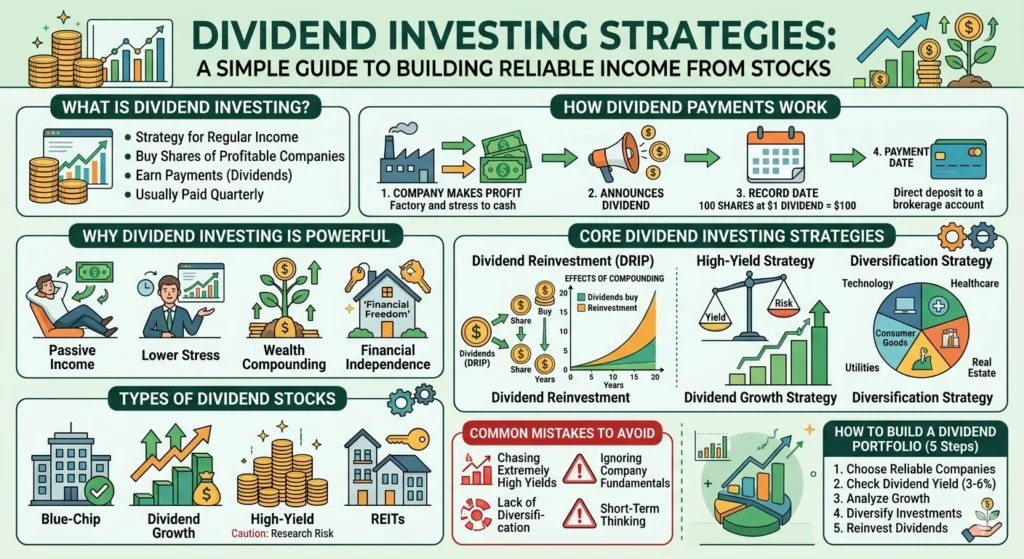
Table of Contents
- What Is Dividend Investing
- How Dividend Payments Work
- Why Dividend Investing Is Powerful
- Types of Dividend Stocks
- Core Dividend Investing Strategies
- Dividend Reinvestment Strategy
- High-Yield Dividend Strategy
- Dividend Growth Strategy
- Diversification Strategy
- How to Build a Dividend Portfolio
- Dividend Investing Illustration Example
- Effects of Dividend Compounding
- Common Dividend Investing Mistakes
- Tools for Finding Dividend Stocks
- Final Thoughts on Dividend Investing
- Frequently Asked Questions (FAQ)
What Is Dividend Investing
Dividend investing is an investment strategy where investors buy stocks of companies that regularly pay part of their profits to shareholders.
These payments are called dividends.
Companies distribute dividends as a reward to investors who own their shares.
For example:
If a company declares $1 dividend per share, and you own 100 shares, you will receive:
$100 in dividend payments.
Dividends are usually paid:
- Quarterly (most common)
- Annually
- Sometimes monthly
This means investors can earn consistent income without selling their stocks.
Dividend investing focuses on:
- Stable companies
- Reliable earnings
- Long-term financial growth
How Dividend Payments Work
Dividend payments follow a simple process.
Step 1: Company Makes Profit
When a company earns profits, it may decide to distribute some money to shareholders.
Step 2: Dividend Announcement
The company declares a dividend payment.
Example:
Company announces:
$0.50 per share dividend.
Step 3: Record Date
Only investors who own the stock before the record date will receive the dividend.
Step 4: Payment Date
Dividends are sent to investors’ brokerage accounts.
Illustration
| Shares Owned | Dividend Per Share | Total Dividend |
|---|---|---|
| 10 | $1 | $10 |
| 50 | $1 | $50 |
| 100 | $1 | $100 |
| 500 | $1 | $500 |
The more shares you own, the higher your dividend income.
Why Dividend Investing Is Powerful
Dividend investing has several advantages compared to other strategies.
1 Stable Passive Income
Dividends provide regular income without selling investments.
2 Lower Investment Stress
Even when stock prices fluctuate, dividends continue to pay investors.
3 Compounding Wealth
Reinvested dividends buy more shares, which produce even more dividends.
4 Long-Term Financial Growth
Many dividend companies also increase payments every year.
5 Financial Independence
Many investors aim to reach a point where dividend income covers their living expenses.
Types of Dividend Stocks
Not all dividend stocks are the same. Investors usually focus on specific categories.
Blue-Chip Dividend Stocks
These are large, stable companies with strong financial history.
Characteristics:
- Reliable dividend payments
- Strong business models
- Lower risk
Dividend Growth Stocks
These companies increase their dividends every year.
This helps investors fight inflation while increasing income.
High-Yield Dividend Stocks
These companies offer higher dividend payouts compared to average stocks.
However, some high yields may carry higher risk.
REIT Dividend Stocks
Real Estate Investment Trusts (REITs) must distribute most of their profits as dividends.
They often pay very attractive income to investors.
Core Dividend Investing Strategies
Successful dividend investors follow specific strategies to maximize income and growth.
Below are the most popular and effective strategies.
Dividend Reinvestment Strategy
One of the most powerful dividend strategies is Dividend Reinvestment.
Instead of withdrawing dividends, investors use the money to buy more shares.
This creates compound growth.
Example
Initial Investment:
$1,000 in dividend stocks
Dividend Yield: 5%
Yearly Dividend:
$50
If reinvested:
Next year you earn dividends on $1,050 instead of $1,000.
Over time this effect becomes extremely powerful.
Illustration
| Year | Investment Value | Dividend |
|---|---|---|
| Year 1 | $1,000 | $50 |
| Year 2 | $1,050 | $52 |
| Year 5 | $1,276 | $63 |
| Year 10 | $1,628 | $81 |
This is called dividend compounding.
To understand how stocks and dividends work, read our guide on
stock market basics.
High-Yield Dividend Strategy
Some investors focus on stocks with high dividend yields.
Dividend Yield Formula:
Dividend Yield = Annual Dividend ÷ Stock Price
Example
Stock Price: $50
Annual Dividend: $3
Dividend Yield:
6%
This means for every $1,000 invested, you receive:
$60 yearly dividend.
Benefits
- Immediate income
- Good for retirees
- Faster cash flow
Risks
Very high dividend yields may signal:
- Financial problems
- Unsustainable payouts
Therefore research is important.
Dividend Growth Strategy
Many experienced investors prefer dividend growth stocks.
These companies increase dividends consistently.
Example
Company Dividend Growth
| Year | Dividend |
|---|---|
| Year 1 | $1 |
| Year 2 | $1.10 |
| Year 3 | $1.25 |
| Year 4 | $1.40 |
Your income increases every year without buying more shares.
Benefits
- Protection against inflation
- Growing passive income
- Strong company stability
Diversification Strategy
Successful dividend investors never rely on a single company.
Instead, they spread investments across multiple sectors.
Example Portfolio
| Sector | Investment |
|---|---|
| Technology | 20% |
| Healthcare | 20% |
| Consumer Goods | 20% |
| Utilities | 20% |
| Real Estate | 20% |
Diversification helps reduce risk.
If one company cuts dividends, other stocks can maintain income.
How to Build a Dividend Portfolio
Building a dividend portfolio can be done step-by-step.
Step 1 Choose Reliable Companies
Look for companies with:
- Strong profits
- Long dividend history
- Stable business models
Step 2 Check Dividend Yield
Good dividend yield usually ranges between:
3% – 6%
Very high yields should be researched carefully.
Step 3 Analyze Dividend Growth
Companies that increase dividends regularly are stronger long-term investments.
Step 4 Diversify Investments
Spread investments across industries.
Avoid putting all your money in one company.
Step 5 Reinvest Dividends
Reinvesting dividends accelerates wealth building.
Dividend Investing Illustration Example
Let’s consider a practical example.
Investor: Sarah
Investment: $10,000
Dividend Yield: 5%
Annual Dividend:
$500
Scenario 1: No Reinvestment
After 10 years:
Income remains $500 per year.
Scenario 2: Dividend Reinvestment
If dividends are reinvested every year:
Investment could grow to around:
$16,000+
Dividend income becomes:
$800+ yearly
This shows the power of compounding.
Effects of Dividend Compounding
Dividend compounding is one of the strongest forces in long-term investing.
Example Growth
Initial Investment: $5,000
Dividend Yield: 5%
After 20 Years With Reinvestment:
Investment Value: $13,000+
Annual Dividend:
$650+
Benefits of Compounding
- Accelerated wealth growth
- Increasing passive income
- Long-term financial stability
Common Dividend Investing Mistakes
Even though dividend investing is simple, many beginners make mistakes.
Chasing Extremely High Dividend Yields
Some stocks offer 12%+ yields but may cut dividends later.
Always check company financial strength.
Lack of Diversification
Investing in only one sector increases risk.
Spread investments across industries.
Ignoring Company Fundamentals
Always review:
- Revenue growth
- Debt levels
- Profit stability
Selling Too Early
Dividend investing works best over long periods.
Short-term thinking reduces potential returns.
Tools for Finding Dividend Stocks
Investors use different tools to research dividend companies.
Some helpful platforms include:
- Stock screeners
- Financial news websites
- Brokerage research tools
- Dividend tracking websites
These tools help investors evaluate:
- Dividend yield
- Payout ratio
- Dividend growth history
Dividend investing is a powerful way to earn passive income—discover more ideas in
passive income investments.
Final Thoughts on Dividend Investing
Dividend investing remains one of the most reliable strategies for building long-term wealth.
It combines two powerful benefits:
- Regular passive income
- Long-term stock growth
By choosing strong companies, reinvesting dividends, and staying invested for the long term, investors can gradually build a steady income stream and financial independence.
Whether you are a beginner or experienced investor, dividend investing can be an excellent addition to your financial strategy.
Frequently Asked Questions (FAQ)
1 What is dividend investing?
Dividend investing is a strategy where investors buy stocks that regularly pay part of their profits as income.
2 How often are dividends paid?
Most companies pay dividends quarterly, but some pay monthly or annually.
3 Can beginners start dividend investing?
Yes. Dividend investing is one of the easiest strategies for beginners.
4 What is a good dividend yield?
A healthy dividend yield usually ranges between 3% and 6%.
5 Is dividend investing safe?
No investment is completely risk-free, but dividend stocks are generally more stable than growth stocks.
6 Should I reinvest dividends?
Reinvesting dividends helps grow your investment through compounding.
7 How much money do I need to start?
You can start with small amounts. Many brokers allow investing with very little money.
8 Do dividends increase over time?
Many companies increase their dividends regularly, especially dividend growth companies.
9 Are dividends taxable?
In many countries dividends may be subject to taxes depending on local tax laws.
10 Can dividend income replace a salary?
With a large enough portfolio, dividend income can eventually cover living expenses.