
A Complete Guide to Smart Banking Decisions
Choosing the right bank account isn’t just a financial decision—it’s a life decision.
Your bank account is where your money lives, grows, and moves. It influences how you save, spend, invest, and even how secure your finances are. Yet, many people rush into opening accounts without fully understanding the long-term impact.
The result?
Hidden fees, low interest, poor services—and missed financial opportunities.
But here’s the good news:
With the right knowledge and strategy, you can choose a bank account that works for you, not against you.
This comprehensive guide will walk you through everything you need to know about choosing the best bank accounts—whether you’re a student, salary earner, entrepreneur, or investor.
Table of Contents
- What Is a Bank Account?
- Why Choosing the Right Bank Account Matters
- Types of Bank Accounts Explained
- Key Features to Look For
- Comparing Bank Accounts: What Really Matters
- Fees and Hidden Charges
- Interest Rates and Savings Growth
- Accessibility and Digital Banking Features
- Security and Safety Considerations
- Choosing Based on Your Financial Goals
- Best Accounts for Different Lifestyles
- Common Mistakes to Avoid
- Real-Life Examples
- Comparison Tables
- FAQs
- Summary
What Is a Bank Account?
A bank account is a financial tool that allows you to store money, make transactions, and manage your finances securely.
It serves as the foundation of your financial life, enabling:
- Deposits and withdrawals
- Payments and transfers
- Savings and investment growth
Why Choosing the Right Bank Account Matters
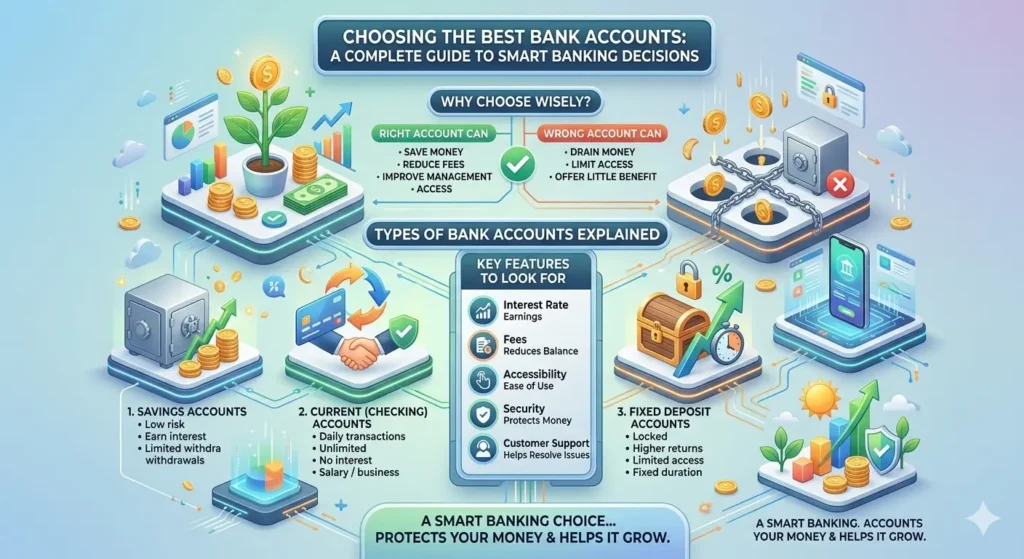
The right account can:
- Help you save more money
- Reduce unnecessary fees
- Improve financial management
- Provide better access to your funds
The wrong account can:
- Drain your money through hidden charges
- Limit your access
- Offer little or no benefits
Types of Bank Accounts Explained
Understanding account types is the first step.
1. Savings Accounts
Designed for storing money and earning interest.
Features:
- Low risk
- Earn interest
- Limited withdrawals
2. Current (Checking) Accounts
Used for daily transactions.
Features:
- Unlimited transactions
- No interest (in most cases)
- Suitable for salary and business use
3. Fixed Deposit Accounts
Money is locked for a period to earn higher interest.
Features:
- Higher returns
- Limited access
- Fixed duration
4. Digital/Online Accounts
Operated entirely online.
Features:
- Low fees
- Easy access
- Mobile banking tools
Key Features to Look For
Before choosing an account, evaluate these features carefully.
Essential Features:
| Feature | Why It Matters |
|---|---|
| Interest Rate | Determines your earnings |
| Fees | Reduces your balance |
| Accessibility | Ease of use |
| Security | Protects your money |
| Customer Support | Helps resolve issues |
Comparing Bank Accounts: What Really Matters
Not all accounts are equal—even if they look similar.
Example Comparison:
| Feature | Bank A | Bank B |
|---|---|---|
| Monthly Fee | $5 | $0 |
| Interest Rate | 1% | 2% |
| ATM Access | Limited | Wide network |
Insight:
Even a small difference in interest can grow significantly over time.
Fees and Hidden Charges
Fees are one of the biggest traps in banking.
Common Fees:
- Maintenance fees
- ATM withdrawal fees
- Transfer fees
- Overdraft fees
Illustration:
If your account charges $5/month:
- $5 × 12 = $60/year lost
Interest Rates and Savings Growth
Interest determines how your money grows.
Example:
| Savings Amount | Interest Rate | Annual Gain |
|---|---|---|
| $1,000 | 1% | $10 |
| $1,000 | 3% | $30 |
Tip:
Always choose accounts with competitive rates.
Accessibility and Digital Banking Features
Modern banking should be easy and fast.
Look For:
- Mobile apps
- Online transfers
- ATM availability
- 24/7 access
Example:
A good mobile app allows you to:
- Check balance instantly
- Transfer money
- Pay bills
Security and Safety Considerations
Your money must be protected.
Key Security Features:
- Two-factor authentication
- Fraud alerts
- Secure login systems
Tip:
Avoid banks with weak digital security systems.
Choosing Based on Your Financial Goals
Your goals determine the best account.
Goal-Based Selection:
| Goal | Best Account Type |
|---|---|
| Saving money | Savings account |
| Daily transactions | Current account |
| Long-term growth | Fixed deposit |
Best Accounts for Different Lifestyles
1. Students
- Low fees
- Easy access
2. Salary Earners
- Reliable payment processing
- ATM access
3. Business Owners
- High transaction limits
- Business tools
4. Investors
- High-interest accounts
- Investment options
Common Mistakes to Avoid
1. Ignoring Fees
2. Choosing Based on Advertising
3. Not Comparing Options
4. Overlooking Digital Features
5. Keeping All Money in One Account
Real-Life Examples
Example 1: Smart Choice
- Chooses zero-fee account
- Earns higher interest
- Uses mobile banking
Result: More savings and convenience
Example 2: Poor Choice
- High fees ignored
- Low interest account
- Limited access
Result: Financial loss
Comparison Tables
Savings vs Current Accounts
| Feature | Savings Account | Current Account |
|---|---|---|
| Interest | Yes | No |
| Transactions | Limited | Unlimited |
| Purpose | Saving | Daily use |
Traditional vs Digital Banks
| Feature | Traditional Bank | Digital Bank |
|---|---|---|
| Physical Branch | Yes | No |
| Fees | Higher | Lower |
| Convenience | Moderate | High |
Frequently Asked Questions (FAQs)
1. What is the best type of bank account?
Depends on your needs—savings for saving, current for transactions.
2. Can I have multiple bank accounts?
Yes, and it’s often beneficial.
3. Are digital banks safe?
Yes, if they use strong security measures.
4. What fees should I avoid?
Monthly maintenance and ATM fees.
5. How do I choose the best bank?
Compare features, fees, and accessibility.
6. Do all savings accounts earn interest?
Most do, but rates vary.
7. Is it good to switch banks?
Yes, if you find better benefits.
8. What is minimum balance?
The amount required to keep your account active.
9. Can I open an account online?
Yes, many banks allow it.
10. How often should I review my account?
At least once a year.
Summary
Choosing the best bank account is one of the most important financial decisions you’ll make.
To get it right:
- Understand account types
- Compare features carefully
- Avoid unnecessary fees
- Choose based on your goals
- Prioritize security and accessibility
A smart banking choice doesn’t just protect your money—it helps it grow.