
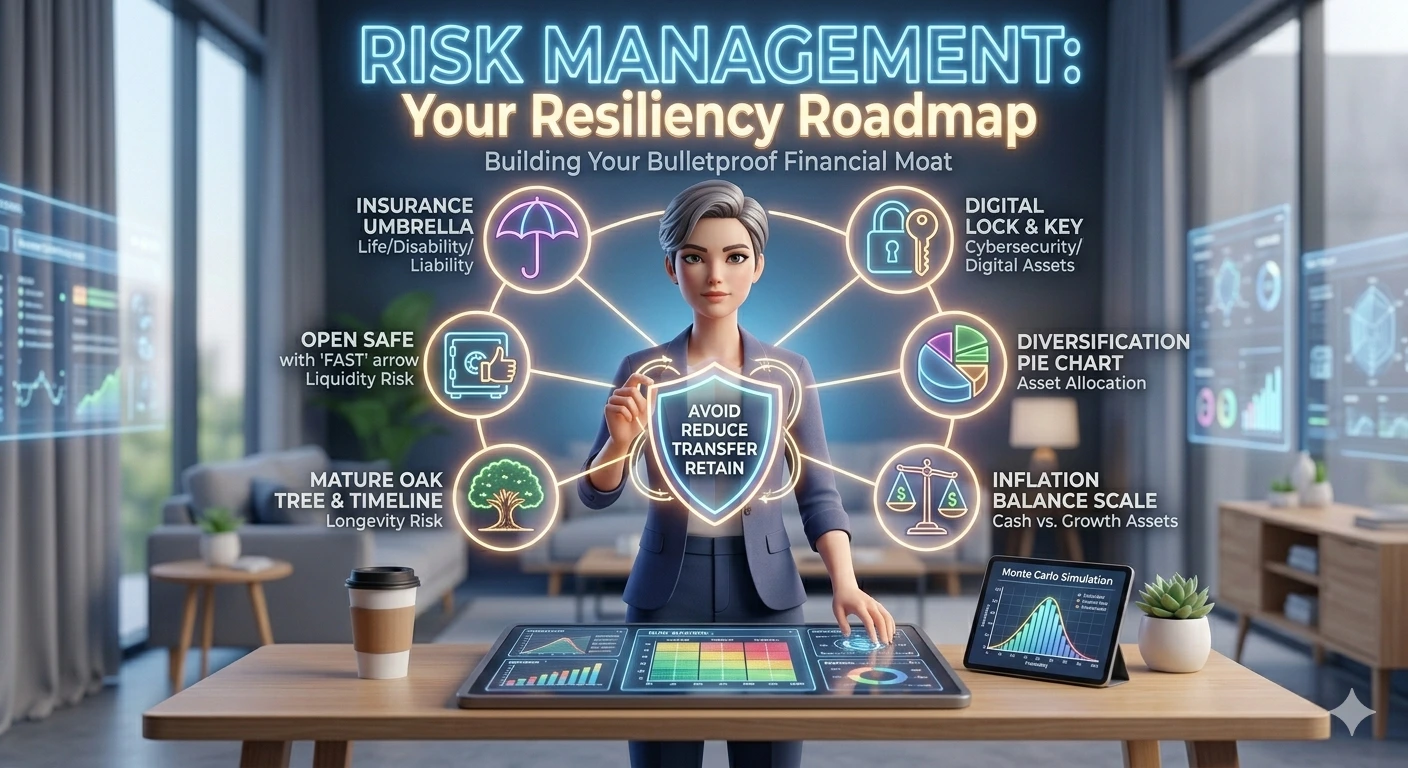
Building Your Bulletproof Financial Moat
Imagine you’ve spent twenty years meticulously building a castle. You’ve laid every brick of your savings, reinforced the towers of your investments, and decorated the halls with the fruits of your labor. Now, imagine that castle has no moat. A single unexpected storm—a medical crisis, a market crash, or a legal liability—could wash away the foundation in an afternoon.
In the financial world of 2026, the “castle” is your net worth, and Risk Management is the moat.
Most people focus entirely on wealth creation—how to make more, how to grow faster, how to beat the market. But the truly wealthy focus on wealth preservation. They know that it doesn’t matter how much you earn if you aren’t disciplined enough to keep it. Risk management isn’t about being afraid; it’s about being prepared. It is the calculated science of identifying what could go wrong and ensuring that when it does, it doesn’t take you down with it.
Whether you are a seasoned investor or just starting your financial journey, this 2,500-word guide will walk you through the essential strategies to identify, assess, and mitigate the risks threatening your financial future.
Table of Contents
- What is Financial Risk Management?
- The Five-Step Risk Management Process
- The Core Strategies: Avoid, Reduce, Transfer, Retain
- Managing Investment Risk in a Volatile Era
- The Insurance Pillar: Transferring the Unbearable
- The Psychology of Risk: Tolerance vs. Capacity
- Cyber Risk and Digital Asset Protection in 2026
- Common Risk Management Mistakes
- Frequently Asked Questions (FAQs)
- Summary: Your Resiliency Roadmap
What is Financial Risk Management?
At its core, financial risk management is the process of understanding and managing the uncertainties that could impact your financial goals. In 2026, these uncertainties have evolved. We are no longer just dealing with stock market volatility; we are navigating algorithmic trading spikes, global inflationary pressures, and the rapid obsolescence of traditional job roles due to AI.
Risk is generally categorized into several forms:
- Market Risk: The possibility of losing money due to fluctuations in the prices of investments.
- Inflation Risk: The danger that the purchasing power of your cash will erode over time.
- Liquidity Risk: The risk of being unable to convert an asset into cash quickly enough to prevent a loss.
- Credit Risk: The risk that a borrower or bond issuer will default on their obligations.
- Longevity Risk: The very real danger of outliving your money in retirement.
The goal of risk management is not to eliminate risk entirely—that’s impossible. Rather, the goal is to optimize the Risk-Reward Tradeoff. You want to take enough risk to grow your wealth but not so much that a single “Black Swan” event wipes you out.
The Five-Step Risk Management Process
Professional risk managers follow a structured cycle to handle threats. You can apply this same logic to your personal finances.
1. Identify the Risks
You cannot manage what you haven’t named. Sit down and list everything that could derail your finances: job loss, a 30% stock market correction, a house fire, or a long-term disability.
2. Analyze and Assess
Once identified, evaluate each risk based on two factors: Probability (How likely is it to happen?) and Impact (How bad will it be if it does?).
- Example: The probability of a flat tire is high, but the impact is low. The probability of a total house fire is low, but the impact is catastrophic.
3. Prioritize
Focus your resources on the “High Impact” risks first. You don’t need a complex strategy for a flat tire (that’s what a small emergency fund is for), but you do need a strategy for the death of a primary breadwinner.
4. Implement Strategies
This is the action phase. This might mean buying an insurance policy, diversifying your portfolio, or setting up a legal trust.
5. Monitor and Review
Risk management is not a “set it and forget it” task. As you get older, get married, have children, or retire, your risk profile changes. An annual “Financial Physical” is required to ensure your moat is still holding water.
The Core Strategies: Avoid, Reduce, Transfer, Retain
In the world of risk, you have four primary moves. Every financial threat you face can be handled using one of these four techniques.
Risk Avoidance
The simplest way to handle risk is to stay away from it. If you are terrified of losing money in the stock market, you could “avoid” that risk by keeping all your money in a savings account. However, notice the tradeoff: by avoiding market risk, you have now accepted 100% inflation risk.
Risk Reduction (Mitigation)
This involves taking steps to minimize the likelihood or the impact of a risk. Installing a security system in your home reduces the risk of theft. Diversifying your investments across 500 companies (like an S&P 500 index fund) reduces the risk of any single company’s failure destroying your wealth.
Risk Transfer
This is the most powerful tool for “catastrophic” risks. You pay a small fee (a premium) to an insurance company, and in exchange, they agree to take on the massive financial burden if something goes wrong. You are transferring the risk from your balance sheet to theirs.
Risk Retention (Acceptance)
Some risks are small enough that you can handle them yourself. This is known as “self-insuring.” When you choose a higher deductible on your car insurance to lower your premium, you are retaining the first $1,000 of risk yourself.
| Strategy | Action Taken | Best Used For… |
| Avoidance | Stop the activity | High-risk, low-reward activities |
| Reduction | Diversify / Install safety | High-probability, manageable-impact risks |
| Transfer | Buy Insurance | Low-probability, high-impact (catastrophic) risks |
| Retention | Emergency Fund | High-probability, low-impact (nuisance) risks |
Managing Investment Risk in a Volatile Era
When it comes to your portfolio, risk management is often synonymous with Asset Allocation. In 2026, the old “60/40” rule (60% stocks, 40% bonds) has been challenged by low bond yields and high volatility.
Modern Diversification
True diversification is not just owning different stocks; it’s owning different types of assets that don’t move in tandem. This includes:
- Equities (Stocks): Domestic, International, and Emerging Markets.
- Fixed Income (Bonds): Government and Corporate.
- Real Assets: Real estate, commodities, and gold.
- Alternative Investments: Private equity or specialized digital assets.
The Power of Rebalancing
Rebalancing is a risk management technique where you periodically sell your “winners” and buy more of your “losers” to return to your target asset allocation.
- Scenario: Your target is 70% stocks and 30% bonds. The stock market has a massive year, and now your portfolio is 80% stocks. You are now taking more risk than you intended. Rebalancing forces you to “sell high” and bring your risk level back to safety.
Hedging with Options
For sophisticated investors, “hedging” acts like an insurance policy for your stocks. By using “Put Options,” you can set a floor on how much you can lose in a market crash. You pay a premium for the option, but it ensures that if the market drops 40%, your portfolio only drops a fraction of that.
The Insurance Pillar: Transferring the Unbearable
Insurance is often viewed as a boring expense, but it is actually the most efficient risk management tool ever invented. It allows you to trade a known, small loss (the premium) for the elimination of an unknown, large loss.
1. Life Insurance
If people depend on your income, life insurance is non-negotiable. In 2026, Term Life Insurance remains the most cost-effective choice for most families, providing high coverage during your working years when your “Human Capital” is your biggest asset.
2. Disability Insurance (Income Protection)
You are statistically more likely to become disabled during your working years than you are to die young. Disability insurance ensures that if you can’t work due to illness or injury, your “paycheck” continues.
3. Umbrella Liability Insurance
In a litigious society, your physical assets are at risk from lawsuits. If you are at fault in a major car accident or if someone gets injured on your property, a standard policy might not be enough. An “Umbrella Policy” provides an extra layer of $1 million to $5 million in liability coverage, protecting your life savings from legal claims.
The Psychology of Risk: Tolerance vs. Capacity
Risk management is as much about your head as it is about your spreadsheet. One of the biggest causes of financial failure is a mismatch between Risk Tolerance and Risk Capacity.
Risk Tolerance (The Sleep Test)
This is your emotional ability to handle a market drop. If you check your accounts every night and feel nauseous when the market is down 2%, your tolerance is low.
Risk Capacity (The Math Test)
This is your financial ability to handle a loss. A 25-year-old has high risk capacity because they have 40 years to recover from a crash. A 64-year-old planning to retire next month has very low risk capacity.
The Trap: Many people have high risk tolerance (they are brave) but low risk capacity (they are broke). Conversely, some have high capacity (they are wealthy) but low tolerance (they are fearful). A smart risk management plan aligns your investments with your capacity first, then adjusts for your tolerance.
Cyber Risk and Digital Asset Protection in 2026
As we move deeper into 2026, the greatest threat to your wealth may not be a market crash, but a digital breach. Financial risk management now includes “Cyber Hygiene.”
- Identity Theft: Use hardware security keys (like YubiKeys) rather than just SMS-based two-factor authentication.
- Social Engineering: The most common way people lose money today is through sophisticated AI-generated deepfake scams. Never authorize a wire transfer based on a voice or video call alone; always verify through a secondary, trusted channel.
- Digital Estate Planning: Ensure your heirs have a secure, encrypted way to access your digital accounts and crypto-assets. Without a “Digital Will,” those assets could be lost forever in the blockchain.
Common Risk Management Mistakes to Avoid
- Over-Insuring Small Risks: Don’t buy “extended warranties” on a $200 appliance. Use your emergency fund for that. Save your insurance dollars for the risks that would actually ruin you.
- Neglecting Inflation: Keeping too much “safe” cash is a risk. If your money isn’t growing, you are guaranteed to lose purchasing power.
- Being “House Rich and Cash Poor”: If 90% of your net worth is tied up in your primary residence, you have massive Liquidity Risk. You can’t eat your kitchen cabinets if you lose your job.
- Ignoring the “Black Swan”: Just because something hasn’t happened in 20 years doesn’t mean it won’t happen tomorrow. Always have a “Plan B.”
Comparison: Traditional vs. Modern Risk Management
| Feature | Traditional (1990s) | Modern (2026) |
| Primary Tool | Bonds and Life Insurance | Global Diversification, Cyber Security, AI Scrutiny |
| Emergency Fund | 3 months of expenses | 6–12 months (due to job volatility) |
| Threat Focus | Market Volatility | Volatility + Cyber Theft + AI Disruption |
| Communication | Quarterly paper statements | Real-time app alerts and AI-driven monitoring |
| Asset Mix | Stocks/Bonds | Stocks/Bonds/Real Estate/Digital Assets |
Frequently Asked Questions (FAQs)
Q: How much should I have in my emergency fund?
A: In 2026, the standard has shifted from 3 months to 6–12 months of essential living expenses. The “Gig Economy” and AI-driven job shifts mean it might take longer to find a new income stream than it did in the past.
Q: Is “Gold” a good risk management tool?
A: Gold is a “Store of Value.” It doesn’t produce cash flow, but it tends to hold its value when currencies are devalued. Most advisors suggest it should represent no more than 5-10% of a diversified portfolio as a hedge against systemic collapse.
Q: Should I get “Long-Term Care” (LTC) insurance?
A: LTC is essential for those between the ages of 55 and 65. The cost of a nursing home or in-home care in 2026 can easily exceed $10,000 per month. Transferring this risk to an insurance company protects your legacy for your children.
Q: What is the “Sequence of Returns” risk?
A: This is the risk that a market crash happens right as you start your retirement. Even if the market eventually recovers, taking withdrawals during a down market can permanently deplete your nest egg. Managing this involves moving to a “Cash Bucket” strategy 2-3 years before you retire.
Q: Can I manage risk using AI?
A: Yes. Many modern portfolio tools use AI to run “Monte Carlo Simulations.” These run thousands of “what-if” scenarios (recessions, wars, high inflation) to see if your financial plan survives.
Summary: Your Resiliency Roadmap
Risk management is the difference between a temporary setback and a permanent financial disaster. You cannot control the wind—the global economy, the stock market, or the next pandemic—but you can adjust your sails.
To build your resilient future starting today:
- Fund your Emergency Moat: Get at least 6 months of cash into a high-yield savings account.
- Audit your Insurance: Ensure you have enough Life, Disability, and Umbrella coverage.
- Diversify your Assets: Don’t let your future depend on a single company, a single industry, or even a single currency.
- Practice Digital Safety: Secure your accounts with hardware keys and be skeptical of AI-driven scams.
By mastering the art of the “Financial Moat,” you ensure that your castle remains standing no matter what the 2026 economy throws at it. Don’t wait for the storm to start building your moat. Start today.
Comparison of Risk Management Styles
| The Gambler | The Hoarder | The Strategist |
| Focuses only on returns | Focuses only on safety | Focuses on risk-adjusted returns |
| Has no insurance | Has no investments | Uses insurance for big risks, investments for growth |
| Panic sells during crashes | Loses money to inflation every day | Rebalances during market swings |
| Result: Likely to go bust | Result: Safe, but poor | Result: Long-term wealth and peace |