

Understanding How the Market Works
The stock market is one of the most powerful wealth-building systems in the world. Every day, billions of dollars move through financial markets as individuals and institutions buy and sell shares of companies. Yet for many beginners, the stock market can seem confusing, intimidating, or even risky.
The truth is that the stock market is simply a marketplace where investors buy and sell ownership in businesses. When you purchase a stock, you own a small part of that company. If the company grows and becomes more profitable, the value of your investment can increase.
Many of the world’s most successful investors started with very little knowledge but learned the fundamentals step by step. Understanding stock market basics is the first step toward building long-term wealth and financial independence.
This guide breaks down the stock market in simple terms so beginners can understand how it works, how money is made, and how to start investing wisely.
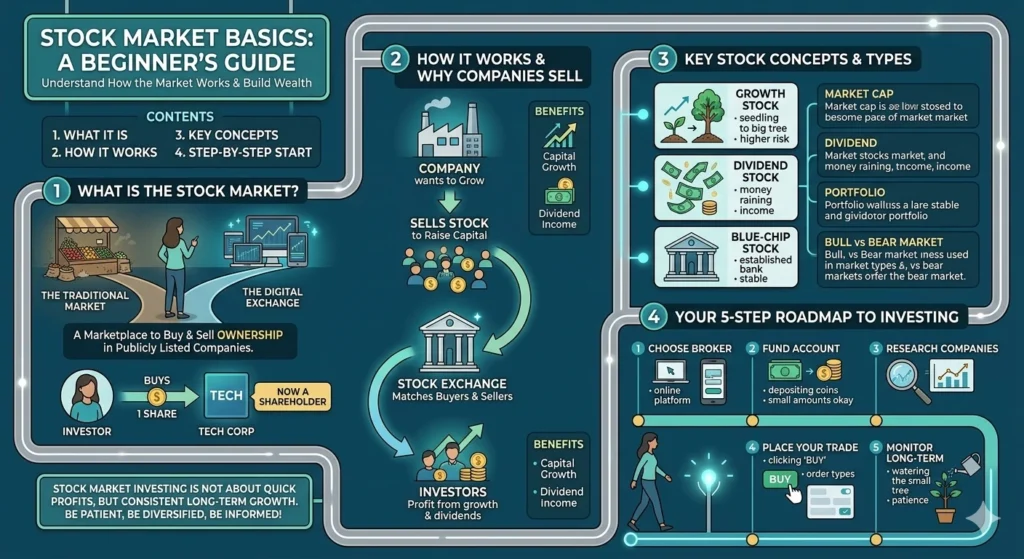
Table of Contents
- What the Stock Market Is
- How the Stock Market Works
- Why Companies Sell Stocks
- Why People Invest in Stocks
- Types of Stocks
- Key Stock Market Terms Beginners Should Know
- How Stock Prices Move
- Stock Market Participants
- Step-by-Step Guide to Buying Your First Stock
- Stock Market Investment Strategies
- Common Beginner Mistakes
- Real-Life Stock Market Examples
- Frequently Asked Questions
- Final Summary
What the Stock Market Is
The stock market is a system where investors buy and sell shares of publicly listed companies.
A stock represents a small ownership stake in a company. When you own a stock, you become a shareholder.
Simple Illustration
| Investor | Company | Ownership |
|---|---|---|
| Sarah | Technology Company | 10 shares |
| David | Retail Company | 20 shares |
Each share represents a portion of ownership.
When the company grows, shareholders benefit from the increase in stock value.
How the Stock Market Works
The stock market operates through exchanges, which are organized platforms where buyers and sellers trade stocks.
Companies list their shares on these exchanges so investors can trade them.
Basic Trading Process
- A company lists its shares on the market
- Investors place buy orders
- Other investors place sell orders
- The exchange matches buyers and sellers
- A trade is completed
Market Flow Chart
Company → Lists Shares → Stock Exchange → Investors Buy/Sell → Market Price Changes
The market price constantly changes based on supply and demand.
Why Companies Sell Stocks
Companies issue stocks primarily to raise capital.
Instead of borrowing money from banks, companies sell shares to investors.
Example
A company wants to expand operations and needs $10 million.
Instead of taking a loan, the company sells shares to the public.
| Capital Source | Amount Raised |
|---|---|
| Bank Loan | $10 million |
| Stock Offering | $10 million |
Selling stocks allows businesses to grow faster without heavy debt.
Why People Invest in Stocks
Investors buy stocks because they offer strong long-term growth potential.
Historically, stocks have produced higher returns than many other investments.
Benefits of Stock Investing
| Benefit | Explanation |
|---|---|
| Capital Growth | Stock prices can rise over time |
| Dividend Income | Some companies pay profits to shareholders |
| Liquidity | Stocks can be bought or sold quickly |
| Ownership | Investors own part of the company |
Types of Stocks
Not all stocks behave the same way. Understanding the different categories helps investors choose wisely.
1. Growth Stocks
Growth stocks belong to companies expected to grow rapidly.
Characteristics:
- High potential returns
- Often reinvest profits instead of paying dividends
- Higher risk
Example industries include technology and innovation sectors.
2. Dividend Stocks
Dividend stocks regularly pay part of company profits to shareholders.
Benefits:
- Passive income
- Long-term stability
- Consistent cash flow
These are popular among income-focused investors.
3. Value Stocks
Value stocks are companies trading below their true market value.
Investors buy them expecting future price increases.
These stocks are often undervalued due to temporary market concerns.
4. Blue-Chip Stocks
Blue-chip stocks belong to large, established companies with strong reputations.
Characteristics:
- Stable growth
- Reliable dividends
- Lower risk compared to small companies
Key Stock Market Terms Beginners Should Know
Understanding basic terminology helps beginners navigate the market confidently.
| Term | Meaning |
|---|---|
| Share | A unit of ownership in a company |
| Market Capitalization | Total value of all company shares |
| Dividend | Profit paid to shareholders |
| Portfolio | Collection of investments |
| Bull Market | Rising market prices |
| Bear Market | Falling market prices |
| Volatility | Degree of price fluctuations |
Learning these concepts improves financial literacy and decision-making.
How Stock Prices Move
Stock prices constantly fluctuate due to multiple factors.
Major Factors Affecting Prices
| Factor | Impact |
|---|---|
| Company earnings | Strong earnings increase stock value |
| Economic conditions | Growth improves investor confidence |
| Interest rates | Higher rates may reduce stock demand |
| Market sentiment | Investor emotions influence buying |
Illustration of Market Movement
Positive News → More Buyers → Price Increases
Negative News → More Sellers → Price Declines
Prices reflect expectations about the future performance of companies.
Stock Market Participants
The stock market includes different types of participants.
Retail Investors
Individual investors buying stocks for personal wealth building.
Institutional Investors
Large organizations managing massive investment funds.
Examples include:
- pension funds
- mutual funds
- investment firms
Market Makers
Specialized firms that ensure liquidity by continuously buying and selling stocks.
Step-by-Step Guide to Buying Your First Stock
Beginners can start investing by following a simple process.
Step 1: Choose a Brokerage Account
A brokerage platform allows investors to buy and sell stocks.
Examples of brokerage features:
- online trading platforms
- investment research tools
- portfolio tracking
Step 2: Fund Your Account
Deposit money into your brokerage account.
Example starting budgets:
| Investor | Starting Amount |
|---|---|
| Beginner | $100 |
| Moderate investor | $500 |
| Serious investor | $1,000+ |
Starting small is perfectly acceptable.
Step 3: Research Companies
Before buying a stock, analyze the company.
Key research areas:
- company revenue
- profit growth
- industry outlook
- management quality
Step 4: Place Your First Trade
Investors submit an order to purchase shares.
Common order types:
| Order Type | Meaning |
|---|---|
| Market Order | Buy immediately at current price |
| Limit Order | Buy only at a specific price |
Step 5: Monitor Your Portfolio
Investing is a long-term process.
Avoid checking prices constantly or making emotional decisions.
Stock Market Investment Strategies
Successful investors follow disciplined strategies rather than guessing.
1. Long-Term Investing
Investors buy quality companies and hold them for years.
Benefits:
- compound growth
- reduced trading costs
- lower stress
2. Diversification Strategy
Diversification spreads investments across multiple stocks or industries.
Example portfolio:
| Sector | Allocation |
|---|---|
| Technology | 30% |
| Healthcare | 20% |
| Finance | 20% |
| Consumer Goods | 15% |
| Energy | 15% |
This reduces overall investment risk.
3. Dollar-Cost Averaging
Investing a fixed amount regularly regardless of market conditions.
Example:
| Month | Investment | Price | Shares |
|---|---|---|---|
| January | $100 | $10 | 10 |
| February | $100 | $8 | 12.5 |
| March | $100 | $12 | 8.3 |
This strategy smooths market volatility.
Common Beginner Mistakes
Many beginners lose money because they ignore basic principles.
1. Investing Without Research
Buying stocks based only on tips or rumors is risky.
2. Emotional Trading
Fear and greed cause impulsive decisions.
3. Lack of Diversification
Investing all funds in one company increases risk.
4. Trying to Time the Market
Predicting short-term market movements is extremely difficult.
5. Ignoring Long-Term Goals
Wealth building requires patience and consistency.
Real-Life Stock Market Examples
Example 1: Long-Term Growth
An investor purchases $1,000 worth of stock in a growing company.
| Year | Value |
|---|---|
| 1 | $1,080 |
| 5 | $1,469 |
| 10 | $2,159 |
Compound growth significantly increases value.
Example 2: Diversified Portfolio
Instead of buying one stock, an investor buys shares in five companies.
| Company | Investment |
|---|---|
| Company A | $200 |
| Company B | $200 |
| Company C | $200 |
| Company D | $200 |
| Company E | $200 |
Diversification spreads risk across multiple businesses.
Frequently Asked Questions
1. What is the stock market?
The stock market is a marketplace where investors buy and sell shares of publicly traded companies.
2. Can beginners invest in stocks?
Yes. Many platforms allow beginners to start investing with small amounts.
3. Is the stock market risky?
Yes, but diversification and long-term investing reduce risk.
4. How do investors make money?
Investors profit from stock price increases and dividend payments.
5. What is a stock exchange?
A stock exchange is a marketplace where stocks are bought and sold.
6. What is a dividend?
A dividend is a portion of company profits paid to shareholders.
7. Can stocks lose value?
Yes. Stock prices fluctuate due to economic conditions and company performance.
8. How long should I hold stocks?
Long-term investing typically produces better results than short-term trading.
9. What is diversification?
Diversification means spreading investments across different companies or industries.
10. How much money do I need to start?
You can start investing with as little as $50 to $100 depending on the brokerage platform.
Quick Concept Chart
| Concept | Meaning |
|---|---|
| Stock | Ownership in a company |
| Exchange | Market where stocks are traded |
| Dividend | Profit shared with investors |
| Portfolio | Collection of investments |
| Diversification | Spreading risk |
Final Summary
The stock market is a powerful financial system that allows individuals to invest in companies and grow their wealth over time. While it may appear complex initially, understanding the basics makes investing much easier.
Beginners should focus on learning how the market works, researching companies carefully, diversifying investments, and maintaining a long-term perspective. By following disciplined strategies and avoiding emotional decisions, investors can build strong financial foundations.
Stock market investing is not about quick profits but about consistent growth. With patience, education, and smart planning, anyone can participate in the stock market and work toward long-term financial success.
A Complete Beginner’s Guide to Understanding How the Market Works
The stock market is one of the most powerful wealth-building systems in the world. Every day, billions of dollars move through financial markets as individuals and institutions buy and sell shares of companies. Yet for many beginners, the stock market can seem confusing, intimidating, or even risky.
The truth is that the stock market is simply a marketplace where investors buy and sell ownership in businesses. When you purchase a stock, you own a small part of that company. If the company grows and becomes more profitable, the value of your investment can increase.
Many of the world’s most successful investors started with very little knowledge but learned the fundamentals step by step. Understanding stock market basics is the first step toward building long-term wealth and financial independence.
This guide breaks down the stock market in simple terms so beginners can understand how it works, how money is made, and how to start investing wisely.
Table of Contents
- What the Stock Market Is
- How the Stock Market Works
- Why Companies Sell Stocks
- Why People Invest in Stocks
- Types of Stocks
- Key Stock Market Terms Beginners Should Know
- How Stock Prices Move
- Stock Market Participants
- Step-by-Step Guide to Buying Your First Stock
- Stock Market Investment Strategies
- Common Beginner Mistakes
- Real-Life Stock Market Examples
- Frequently Asked Questions
- Final Summary
What the Stock Market Is
The stock market is a system where investors buy and sell shares of publicly listed companies.
A stock represents a small ownership stake in a company. When you own a stock, you become a shareholder.
Simple Illustration
| Investor | Company | Ownership |
|---|---|---|
| Sarah | Technology Company | 10 shares |
| David | Retail Company | 20 shares |
Each share represents a portion of ownership.
When the company grows, shareholders benefit from the increase in stock value.
How the Stock Market Works
The stock market operates through exchanges, which are organized platforms where buyers and sellers trade stocks.
Companies list their shares on these exchanges so investors can trade them.
Basic Trading Process
- A company lists its shares on the market
- Investors place buy orders
- Other investors place sell orders
- The exchange matches buyers and sellers
- A trade is completed
Market Flow Chart
Company → Lists Shares → Stock Exchange → Investors Buy/Sell → Market Price Changes
The market price constantly changes based on supply and demand.
Why Companies Sell Stocks
Companies issue stocks primarily to raise capital.
Instead of borrowing money from banks, companies sell shares to investors.
Example
A company wants to expand operations and needs $10 million.
Instead of taking a loan, the company sells shares to the public.
| Capital Source | Amount Raised |
|---|---|
| Bank Loan | $10 million |
| Stock Offering | $10 million |
Selling stocks allows businesses to grow faster without heavy debt.
Why People Invest in Stocks
Investors buy stocks because they offer strong long-term growth potential.
Historically, stocks have produced higher returns than many other investments.
Benefits of Stock Investing
| Benefit | Explanation |
|---|---|
| Capital Growth | Stock prices can rise over time |
| Dividend Income | Some companies pay profits to shareholders |
| Liquidity | Stocks can be bought or sold quickly |
| Ownership | Investors own part of the company |
Types of Stocks
Not all stocks behave the same way. Understanding the different categories helps investors choose wisely.
1. Growth Stocks
Growth stocks belong to companies expected to grow rapidly.
Characteristics:
- High potential returns
- Often reinvest profits instead of paying dividends
- Higher risk
Example industries include technology and innovation sectors.
2. Dividend Stocks
Dividend stocks regularly pay part of company profits to shareholders.
Benefits:
- Passive income
- Long-term stability
- Consistent cash flow
These are popular among income-focused investors.
3. Value Stocks
Value stocks are companies trading below their true market value.
Investors buy them expecting future price increases.
These stocks are often undervalued due to temporary market concerns.
4. Blue-Chip Stocks
Blue-chip stocks belong to large, established companies with strong reputations.
Characteristics:
- Stable growth
- Reliable dividends
- Lower risk compared to small companies
Key Stock Market Terms Beginners Should Know
Understanding basic terminology helps beginners navigate the market confidently.
| Term | Meaning |
|---|---|
| Share | A unit of ownership in a company |
| Market Capitalization | Total value of all company shares |
| Dividend | Profit paid to shareholders |
| Portfolio | Collection of investments |
| Bull Market | Rising market prices |
| Bear Market | Falling market prices |
| Volatility | Degree of price fluctuations |
Learning these concepts improves financial literacy and decision-making.
How Stock Prices Move
Stock prices constantly fluctuate due to multiple factors.
Major Factors Affecting Prices
| Factor | Impact |
|---|---|
| Company earnings | Strong earnings increase stock value |
| Economic conditions | Growth improves investor confidence |
| Interest rates | Higher rates may reduce stock demand |
| Market sentiment | Investor emotions influence buying |
Illustration of Market Movement
Positive News → More Buyers → Price Increases
Negative News → More Sellers → Price Declines
Prices reflect expectations about the future performance of companies.
Stock Market Participants
The stock market includes different types of participants.
Retail Investors
Individual investors buying stocks for personal wealth building.
Institutional Investors
Large organizations managing massive investment funds.
Examples include:
- pension funds
- mutual funds
- investment firms
Market Makers
Specialized firms that ensure liquidity by continuously buying and selling stocks.
Step-by-Step Guide to Buying Your First Stock
Beginners can start investing by following a simple process.
Step 1: Choose a Brokerage Account
A brokerage platform allows investors to buy and sell stocks.
Examples of brokerage features:
- online trading platforms
- investment research tools
- portfolio tracking
Step 2: Fund Your Account
Deposit money into your brokerage account.
Example starting budgets:
| Investor | Starting Amount |
|---|---|
| Beginner | $100 |
| Moderate investor | $500 |
| Serious investor | $1,000+ |
Starting small is perfectly acceptable.
Step 3: Research Companies
Before buying a stock, analyze the company.
Key research areas:
- company revenue
- profit growth
- industry outlook
- management quality
Step 4: Place Your First Trade
Investors submit an order to purchase shares.
Common order types:
| Order Type | Meaning |
|---|---|
| Market Order | Buy immediately at current price |
| Limit Order | Buy only at a specific price |
Step 5: Monitor Your Portfolio
Investing is a long-term process.
Avoid checking prices constantly or making emotional decisions.
Stock Market Investment Strategies
Successful investors follow disciplined strategies rather than guessing.
1. Long-Term Investing
Investors buy quality companies and hold them for years.
Benefits:
- compound growth
- reduced trading costs
- lower stress
2. Diversification Strategy
Diversification spreads investments across multiple stocks or industries.
Example portfolio:
| Sector | Allocation |
|---|---|
| Technology | 30% |
| Healthcare | 20% |
| Finance | 20% |
| Consumer Goods | 15% |
| Energy | 15% |
This reduces overall investment risk.
3. Dollar-Cost Averaging
Investing a fixed amount regularly regardless of market conditions.
Example:
| Month | Investment | Price | Shares |
|---|---|---|---|
| January | $100 | $10 | 10 |
| February | $100 | $8 | 12.5 |
| March | $100 | $12 | 8.3 |
This strategy smooths market volatility.
Common Beginner Mistakes
Many beginners lose money because they ignore basic principles.
1. Investing Without Research
Buying stocks based only on tips or rumors is risky.
2. Emotional Trading
Fear and greed cause impulsive decisions.
3. Lack of Diversification
Investing all funds in one company increases risk.
4. Trying to Time the Market
Predicting short-term market movements is extremely difficult.
5. Ignoring Long-Term Goals
Wealth building requires patience and consistency.
Real-Life Stock Market Examples
Example 1: Long-Term Growth
An investor purchases $1,000 worth of stock in a growing company.
| Year | Value |
|---|---|
| 1 | $1,080 |
| 5 | $1,469 |
| 10 | $2,159 |
Compound growth significantly increases value.
Example 2: Diversified Portfolio
Instead of buying one stock, an investor buys shares in five companies.
| Company | Investment |
|---|---|
| Company A | $200 |
| Company B | $200 |
| Company C | $200 |
| Company D | $200 |
| Company E | $200 |
Diversification spreads risk across multiple businesses.
Frequently Asked Questions
1. What is the stock market?
The stock market is a marketplace where investors buy and sell shares of publicly traded companies.
2. Can beginners invest in stocks?
Yes. Many platforms allow beginners to start investing with small amounts.
3. Is the stock market risky?
Yes, but diversification and long-term investing reduce risk.
4. How do investors make money?
Investors profit from stock price increases and dividend payments.
5. What is a stock exchange?
A stock exchange is a marketplace where stocks are bought and sold.
6. What is a dividend?
A dividend is a portion of company profits paid to shareholders.
7. Can stocks lose value?
Yes. Stock prices fluctuate due to economic conditions and company performance.
8. How long should I hold stocks?
Long-term investing typically produces better results than short-term trading.
9. What is diversification?
Diversification means spreading investments across different companies or industries.
10. How much money do I need to start?
You can start investing with as little as $50 to $100 depending on the brokerage platform.
Quick Concept Chart
| Concept | Meaning |
|---|---|
| Stock | Ownership in a company |
| Exchange | Market where stocks are traded |
| Dividend | Profit shared with investors |
| Portfolio | Collection of investments |
| Diversification | Spreading risk |
Summary
The stock market is a powerful financial system that allows individuals to invest in companies and grow their wealth over time. While it may appear complex initially, understanding the basics makes investing much easier.
Beginners should focus on learning how the market works, researching companies carefully, diversifying investments, and maintaining a long-term perspective. By following disciplined strategies and avoiding emotional decisions, investors can build strong financial foundations.
Stock market investing is not about quick profits but about consistent growth. With patience, education, and smart planning, anyone can participate in the stock market and work toward long-term financial success.