

A Complete Beginner’s Guide to Earning Money While You Sleep
Imagine earning money even when you are not working. While you sleep, travel, or spend time with family, your investments continue generating income. This is the core idea behind passive income investments.
Many people rely entirely on active income such as salaries or wages. The problem with this approach is simple: when work stops, income stops. Passive income changes that equation by creating financial systems that continue producing money with minimal daily effort.
Passive income investments allow individuals to build wealth gradually while reducing financial stress. Over time, these income streams can grow enough to cover expenses, support retirement, or provide financial freedom.
The good news is that passive income investing is not limited to wealthy investors. With the right strategy, beginners can start building passive income using small investments and consistent contributions.
This guide explains everything beginners need to know about passive income investments, including how they work, the best investment options, and step-by-step methods to start generating steady income.
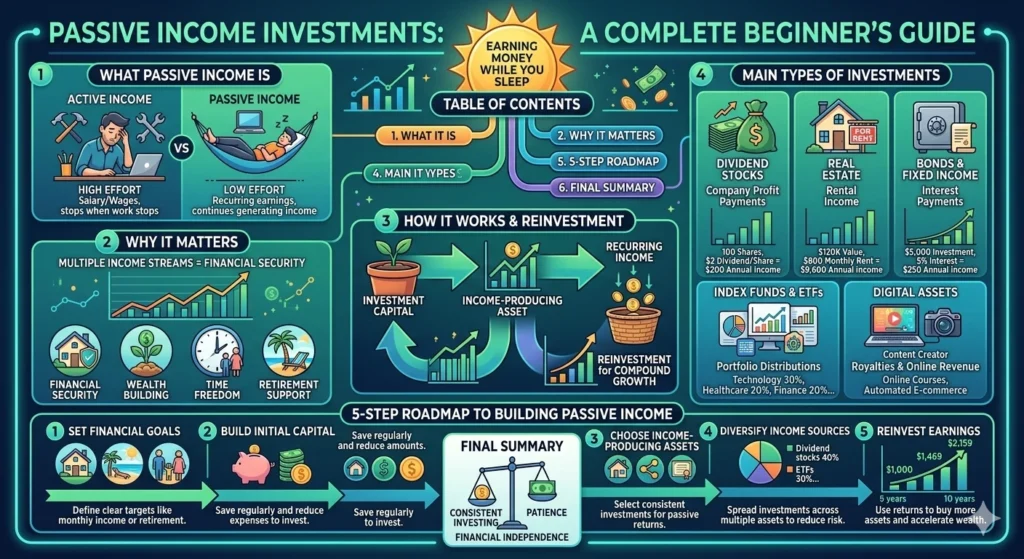
Table of Contents
- What Passive Income Investments Are
- Why Passive Income Matters
- How Passive Income Works
- Main Types of Passive Income Investments
- Dividend Stocks
- Real Estate Income
- Bonds and Fixed Income
- Index Funds and ETFs
- Digital Asset Investments
- Step-by-Step Guide to Building Passive Income
- Passive Income Portfolio Strategy
- Risks to Consider
- Real-Life Examples
- Frequently Asked Questions
- Final Summary
What Passive Income Investments Are
Passive income investments are assets that generate recurring earnings with little ongoing effort.
Once the investment is made, it continues producing income without constant management.
Simple Illustration
| Income Type | Effort Required | Example |
|---|---|---|
| Active Income | High | Salary, hourly jobs |
| Passive Income | Low | Dividends, rental income |
Passive income does not mean zero effort. Most passive investments require research, initial capital, and occasional monitoring.
However, compared to traditional jobs, the ongoing effort is significantly lower.
Why Passive Income Matters
Passive income is one of the most effective ways to build financial independence.
Relying on a single income source creates financial risk. If that income disappears, financial stability is threatened.
Multiple passive income streams provide stability.
Benefits of Passive Income
| Benefit | Explanation |
|---|---|
| Financial Security | Income continues even without active work |
| Wealth Building | Earnings can be reinvested |
| Time Freedom | Less dependence on traditional jobs |
| Retirement Support | Long-term income stream |
Passive income is one of the key strategies used by successful investors worldwide.
How Passive Income Works
Passive income works through assets generating regular returns.
These returns may come from profits, interest, rent, or appreciation.
Income Flow Illustration
Investment Capital
        ↓
   Income-Producing Asset
        ↓
   Recurring Income
        ↓
  Reinvestment for Growth
The reinvestment process accelerates wealth creation.
Main Types of Passive Income Investments
Passive income can be generated from multiple asset classes.
The most common investment categories include:
| Investment Type | Income Source |
|---|---|
| Dividend stocks | Company profit payments |
| Real estate | Rental income |
| Bonds | Interest payments |
| ETFs and funds | Portfolio distributions |
| Digital assets | Royalties or online revenue |
Diversifying across multiple passive income sources increases stability.
Dividend Stocks
Dividend stocks are shares of companies that distribute part of their profits to shareholders.
Investors receive regular payments known as dividends.
How Dividends Work
A company earns profits and distributes a portion to investors.
Dividend Illustration
| Shares Owned | Dividend Per Share | Annual Income |
|---|---|---|
| 100 shares | $2 | $200 |
| 500 shares | $2 | $1,000 |
Dividends can be reinvested to purchase more shares, increasing future income.
Benefits
- Regular income
- Long-term growth
- Compounding potential
Dividend investing is one of the most popular passive income strategies.
Real Estate Income
Real estate investing generates passive income through rental properties.
Investors purchase property and earn income from tenants.
Rental Income Example
| Property Value | Monthly Rent | Annual Income |
|---|---|---|
| $120,000 | $800 | $9,600 |
Real estate also provides potential appreciation in property value.
Benefits
- Consistent cash flow
- Property value growth
- Inflation protection
Some investors also use Real Estate Investment Trusts (REITs) to earn property income without owning physical buildings.
Bonds and Fixed Income
Bonds are loans made by investors to governments or corporations.
In exchange, investors receive regular interest payments.
Bond Example
| Investment | Interest Rate | Annual Income |
|---|---|---|
| $5,000 | 5% | $250 |
Bonds are generally considered lower-risk investments compared to stocks.
Index Funds and ETFs
Index funds and exchange-traded funds invest in large collections of stocks.
These funds often distribute profits to investors.
Example ETF Portfolio
| Sector | Allocation |
|---|---|
| Technology | 30% |
| Healthcare | 20% |
| Finance | 20% |
| Consumer Goods | 15% |
| Energy | 15% |
This diversified exposure reduces risk while generating passive returns.
Digital Asset Investments
Modern technology has introduced new passive income opportunities.
These include:
- online content revenue
- digital product royalties
- automated e-commerce systems
- licensing intellectual property
Example
A digital course created once may generate income repeatedly as people purchase it online.
Step-by-Step Guide to Building Passive Income
Beginners can build passive income by following a structured approach.
Step 1: Set Clear Financial Goals
Examples include:
- retirement income
- covering monthly expenses
- building wealth
Goals determine investment choices.
Step 2: Build Initial Capital
Passive income requires starting capital.
Ways to build capital include:
- saving regularly
- reducing unnecessary expenses
- reinvesting profits
Step 3: Choose Income-Producing Assets
Select investments that generate consistent returns.
Examples:
- dividend stocks
- rental property
- index funds
Step 4: Diversify Income Sources
Diversification reduces dependence on a single investment.
Example diversified passive income portfolio:
| Asset Type | Allocation |
|---|---|
| Dividend stocks | 40% |
| ETFs | 30% |
| Bonds | 15% |
| Real estate | 15% |
Step 5: Reinvest Earnings
Reinvesting income increases future returns.
Growth Illustration
| Year | Investment | Income Reinvested | Total Value |
|---|---|---|---|
| 1 | $1,000 | $80 | $1,080 |
| 5 | — | — | $1,469 |
| 10 | — | — | $2,159 |
Compound growth accelerates passive income over time.
Passive Income Portfolio Strategy
Successful passive income investors build balanced portfolios.
Example Portfolio
| Asset | Income Source |
|---|---|
| Dividend stocks | Quarterly dividends |
| Bonds | Fixed interest |
| Real estate | Monthly rent |
| ETFs | Annual distributions |
This combination creates multiple income streams.
Risks to Consider
All investments involve risk, including passive income investments.
Understanding potential risks helps investors make better decisions.
Major Risks
| Risk | Description |
|---|---|
| Market risk | Stock prices fluctuate |
| Interest rate risk | Bond prices may change |
| Vacancy risk | Rental properties may lack tenants |
| Economic downturn | Income sources may decrease |
Diversification helps reduce these risks.
Real-Life Passive Income Examples
Example 1: Dividend Investor
An investor owns $20,000 in dividend stocks with a 4% yield.
| Investment | Dividend Yield | Annual Income |
|---|---|---|
| $20,000 | 4% | $800 |
Over time, reinvested dividends increase both capital and income.
Example 2: Rental Property Investor
An investor purchases a property and rents it out.
| Monthly Rent | Annual Income |
|---|---|
| $1,000 | $12,000 |
Rental income can grow as property value increases.
Example 3: ETF Investor
An investor buys diversified ETFs worth $10,000.
| Distribution Yield | Annual Income |
|---|---|
| 3% | $300 |
ETFs provide diversified passive income.
Key Passive Income Concepts
| Concept | Meaning |
|---|---|
| Cash Flow | Money generated regularly |
| Yield | Return from investment |
| Compounding | Earnings generating more earnings |
| Diversification | Spreading investments across assets |
Understanding these concepts improves investment success.
Frequently Asked Questions
1. What is passive income investing?
Passive income investing involves purchasing assets that generate recurring income with minimal effort.
2. Can beginners build passive income?
Yes. Beginners can start with small investments and gradually build multiple income streams.
3. What is the best passive income investment?
Common options include dividend stocks, real estate, ETFs, and bonds.
4. Is passive income completely effortless?
No. Initial effort and occasional monitoring are required.
5. How much money do I need to start?
Some passive income investments can start with as little as $50 to $100.
6. Are passive income investments risky?
All investments carry risk, but diversification reduces potential losses.
7. Can passive income replace a full-time job?
Over time, large passive income portfolios can generate enough income to replace salaries.
8. What is the safest passive income investment?
Government bonds and diversified index funds are generally lower-risk options.
9. Should I reinvest passive income?
Yes. Reinvesting earnings accelerates compound growth.
10. How long does it take to build passive income?
Passive income grows gradually. Long-term investing typically produces the best results.
Summary
Passive income investments provide one of the most powerful ways to build financial security and long-term wealth. Instead of relying entirely on active work, investors can create financial systems that generate income continuously.
By investing in assets such as dividend stocks, real estate, bonds, and index funds, individuals can develop multiple income streams that grow over time. The key principles include starting early, diversifying investments, reinvesting earnings, and maintaining a long-term perspective.
While passive income does not happen instantly, consistent investing and disciplined financial habits can transform small investments into powerful income-producing assets.
With patience and strategic planning, passive income investments can help individuals achieve financial independence and greater control over their future.