
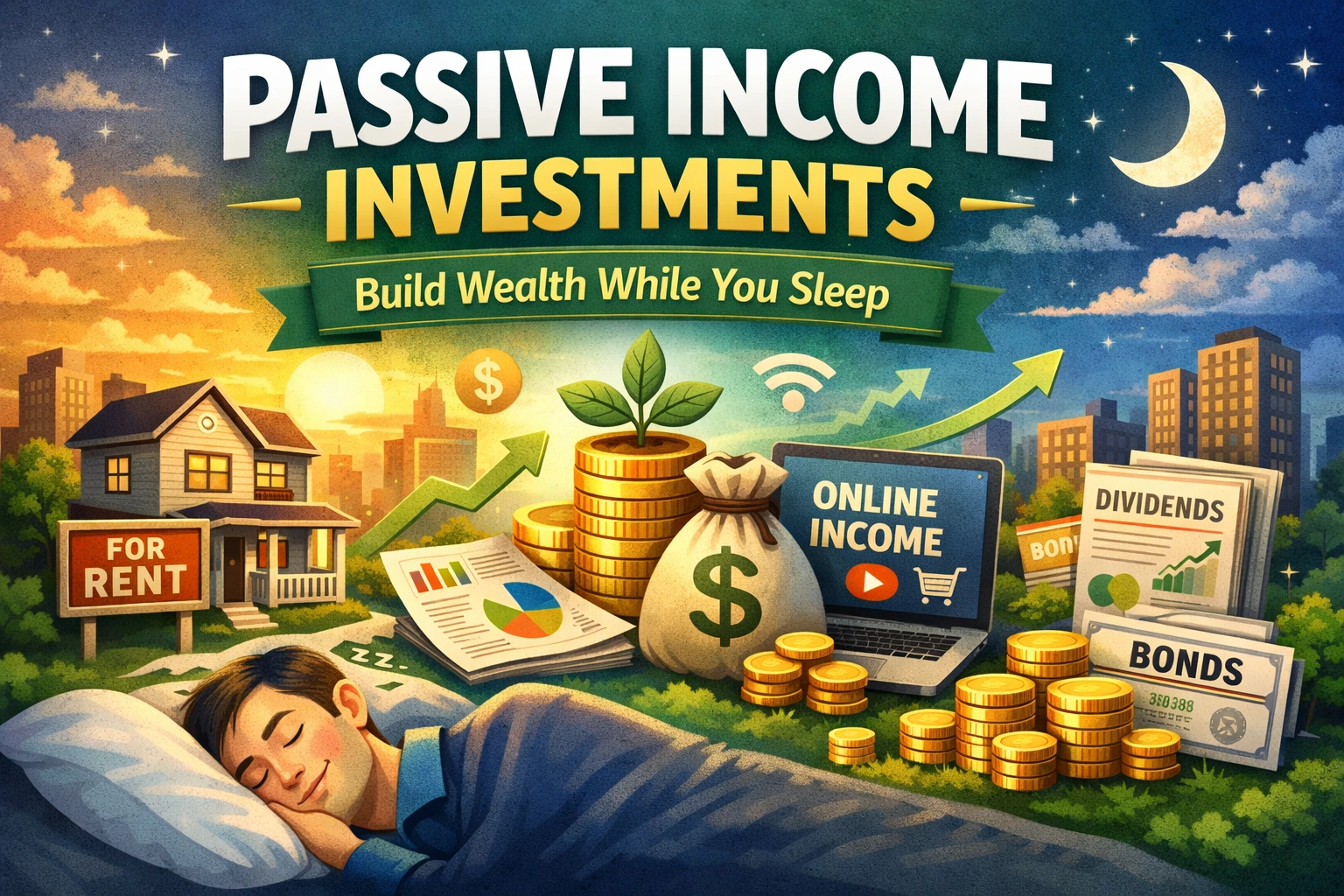
A Beginner’s Guide to Building Income That Works for You
Passive income is one of the most powerful financial strategies anyone can use to build long-term wealth. Instead of trading your time for money every day, passive income allows your money and assets to generate earnings continuously — even while you sleep.
Many successful investors rely on passive income investments to create financial security, achieve financial independence, and reduce dependence on a single paycheck.
The good news is that passive income investing is no longer only for the rich. With the right strategy, planning, and consistency, beginners can start building passive income streams with small amounts of money.
This complete guide will explain passive income investments in simple steps, explore different types of passive income opportunities, and show you how to start building reliable income streams that grow over time.
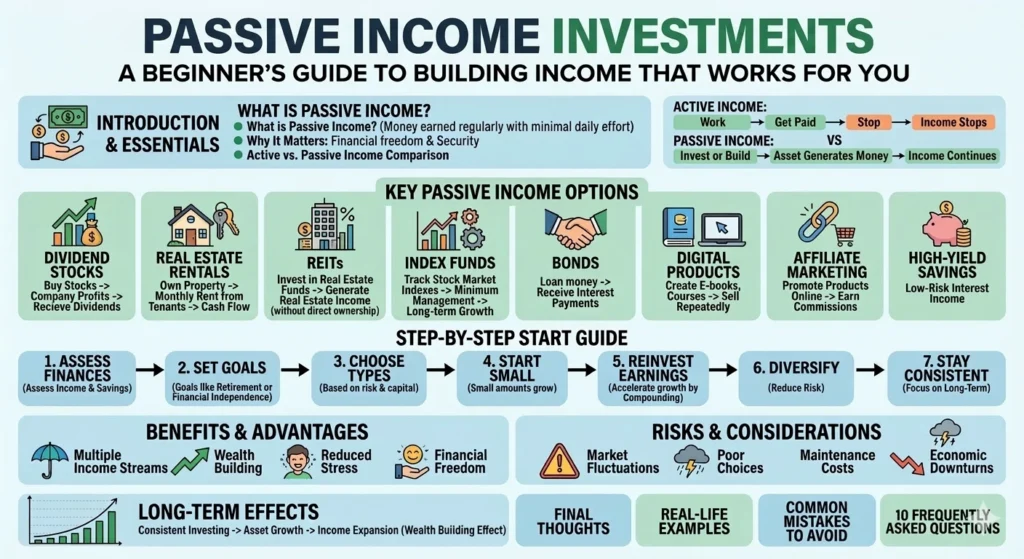
Table of Contents
- What is Passive Income
- Why Passive Income Investments Matter
- Active Income vs Passive Income
- How Passive Income Investments Work
- Top Passive Income Investment Options
- Benefits of Passive Income Investing
- Possible Risks and Challenges
- Step-by-Step Guide to Starting Passive Income Investments
- Real-Life Examples of Passive Income Investors
- Common Mistakes to Avoid
- Long-Term Effects of Passive Income Investing
- Final Thoughts
- Frequently Asked Questions (10 FAQs)
What is Passive Income
Passive income refers to money earned regularly with minimal daily effort after the initial setup.
Unlike traditional jobs where you work for every dollar, passive income continues to generate earnings even when you are not actively working.
Examples of passive income include:
- Rental income from real estate
- Dividends from stocks
- Interest from savings or bonds
- Royalties from digital products
- Income from online businesses
Simple Illustration
Active Income:
Work → Get Paid → Stop Working → Income Stops
Passive Income:
Invest or Build → Asset Generates Money → Income Continues
This is why many financial experts focus heavily on passive income strategies.
Why Passive Income Investments Matter
Passive income plays a critical role in financial freedom and wealth building.
Key Reasons Passive Income is Important
- Financial independence
Passive income reduces dependence on a job. - Extra income stream
Helps cover bills, savings, or investments. - Wealth accumulation
Reinvested income grows faster over time. - Security during emergencies
Multiple income streams reduce financial risk. - Early retirement opportunities
Illustration: Income Structure
Single Income Source
Salary → Expenses → No Backup
Multiple Passive Income Sources
Salary
- Dividends
- Rental income
- Online income
= Strong financial stability
Active Income vs Passive Income
Understanding the difference helps investors build better financial strategies.
| Type | Description | Example |
|---|---|---|
| Active Income | Requires continuous work | Salary, freelancing |
| Passive Income | Earned with minimal ongoing effort | dividends, rental income |
Example
John works a 9-5 job.
- Salary = Active income
- Dividend stocks = Passive income
- Rental property = Passive income
Over time, his passive income could exceed his salary.
How Passive Income Investments Work
Passive income investments involve purchasing or building assets that generate recurring income.
Basic Process
Step 1 — Invest money or effort
Step 2 — Asset generates income
Step 3 — Income grows over time
Investment Growth Illustration
Initial Investment → Asset Creation → Income Generation → Reinvestment → Wealth Growth
This process creates a compound wealth effect.
Top Passive Income Investment Options
Below are some of the most popular passive income investments.
1. Dividend Stocks
Dividend stocks pay investors a portion of company profits regularly.
Example companies known for dividends include well-established corporations.
How it works:
Buy stock → Company earns profit → Company pays dividends → Investor receives income
Example:
Investment: $5,000
Dividend yield: 4%
Annual passive income = $200
2. Real Estate Rentals
Owning rental property allows investors to earn monthly rent.
Illustration
Property Purchase → Tenant Rent → Monthly Cash Flow
Example:
Property price: $80,000
Monthly rent: $700
Annual income: $8,400
After expenses, investors still earn steady passive income.
3. Real Estate Investment Trusts (REITs)
REITs allow investors to earn real estate income without owning property directly.
Benefits include:
- Lower investment requirement
- High dividend yield
- Liquidity
Investors receive dividends from property income.
4. Index Funds
Index funds track stock market indexes and generate long-term returns.
They are ideal for passive investors because they require minimal management.
Example indexes:
- S&P 500
- Global market indexes
Advantages:
- Diversification
- Lower risk than individual stocks
- Long-term growth
5. Bonds
Bonds are loans made to governments or companies.
Investors receive interest payments over time.
Example:
Investment: $10,000
Interest rate: 5%
Annual passive income = $500
6. Digital Products
Digital assets can generate passive income online.
Examples include:
- Online courses
- E-books
- Templates
- Mobile apps
Once created, they can be sold repeatedly.
7. Affiliate Marketing
Affiliate marketing involves promoting products online and earning commissions for sales.
Many bloggers and website owners use this method to generate passive income.
Example:
Blog article → Product recommendation → Customer purchase → Commission earned
8. High-Yield Savings Accounts
Although not high income, savings accounts provide interest income with very low risk.
Example:
Savings: $20,000
Interest: 3%
Annual passive income = $600
Benefits of Passive Income Investing
Passive income investments offer several advantages.
Financial Benefits
- Multiple income streams
- Long-term wealth building
- Reduced financial stress
- Better retirement planning
- Increased financial freedom
Illustration
Income Growth
Year 1 → $500 passive income
Year 3 → $2,000 passive income
Year 10 → $10,000+ passive income
Consistency leads to exponential growth.
Possible Risks and Challenges
Every investment has risks, including passive income strategies.
Common Risks
- Market fluctuations
- Poor investment choices
- Property maintenance costs
- Economic downturns
- Lack of diversification
Risk Management Illustration
Diversified Portfolio
Stocks + Real Estate + Bonds + Online Assets
This reduces exposure to any single risk.
Step-by-Step Guide to Starting Passive Income Investments
Step 1 — Assess Your Finances
Review your income, savings, and expenses.
Determine how much you can invest regularly.
Step 2 — Set Investment Goals
Examples:
- Earn $200 monthly passive income
- Save for retirement
- Achieve financial independence
Clear goals guide investment decisions.
Step 3 — Choose Investment Types
Select investments based on:
- Risk tolerance
- Investment capital
- Time commitment
Beginners often start with:
- index funds
- dividend stocks
Step 4 — Start Small
You do not need large capital to start.
Even small monthly investments grow over time.
Example:
Invest $100 monthly.
After several years, the portfolio becomes significant.
Step 5 — Reinvest Earnings
Reinvest dividends and interest to accelerate growth.
Illustration
Dividend → Reinvest → Buy More Assets → Higher Income
This strategy is called compounding.
Step 6 — Diversify Your Portfolio
Avoid putting all money in one investment.
Diversification reduces risk and improves stability.
Step 7 — Stay Consistent
Passive income takes time.
Successful investors focus on long-term strategies rather than short-term gains.
Real-Life Examples of Passive Income Investors
Example 1 — Dividend Investor
Sarah invests $300 monthly into dividend stocks.
After 10 years:
Portfolio value: $50,000+
Annual dividends: $2,000+
Example 2 — Real Estate Investor
Michael buys a small rental property.
Monthly rent: $900
Mortgage: $500
Monthly passive income = $400
Example 3 — Digital Creator
Emma writes an e-book about personal finance.
Price: $15
Monthly sales: 200 copies
Monthly passive income = $3,000
Common Mistakes to Avoid
Many beginners make avoidable mistakes when pursuing passive income.
Major Mistakes
- Expecting instant results
- Investing without research
- Ignoring diversification
- Spending passive income instead of reinvesting
- Following investment hype
Patience and discipline are essential for success.
Long-Term Effects of Passive Income Investing
Over time, passive income investments can transform financial stability.
Wealth Building Effect
Consistent investing → Asset growth → Passive income expansion
Example projection:
Year 1: $1,000 income
Year 5: $5,000 income
Year 15: $50,000+ income
This gradual growth builds financial independence.
Final Thoughts
Passive income investments are a powerful strategy for building financial freedom and long-term wealth.
By investing in assets such as stocks, real estate, digital products, and bonds, individuals can create multiple income streams that generate money continuously.
While passive income requires initial effort, patience, and discipline, the long-term benefits can be life-changing.
Starting small, investing consistently, and reinvesting profits can help anyone build sustainable passive income over time.
The earlier you start, the more powerful the compounding effect becomes.
Frequently Asked Questions (FAQs)
1. What is the best passive income investment for beginners?
Index funds and dividend stocks are often recommended because they require little management and offer long-term growth.
2. Can passive income replace a full-time job?
Yes, many investors build enough passive income streams to cover their living expenses.
3. How much money do I need to start passive income investing?
You can start with small amounts, sometimes as little as $50 or $100.
4. Is passive income truly passive?
Some investments require initial effort or occasional management, but they generally require far less work than active income.
5. Are passive income investments risky?
All investments carry risk, but diversification and long-term strategies can reduce potential losses.
6. What is the fastest passive income strategy?
Digital products and affiliate marketing can generate income quickly if done correctly.
7. Should I reinvest passive income?
Yes. Reinvesting earnings helps grow your portfolio and increase future income.
8. How long does it take to build significant passive income?
It usually takes several years of consistent investing and reinvestment.
9. Can passive income help with retirement planning?
Yes. Many retirement plans rely heavily on passive income investments like dividends and bonds.
10. What is the biggest mistake beginners make?
Expecting quick profits instead of focusing on long-term wealth building.