
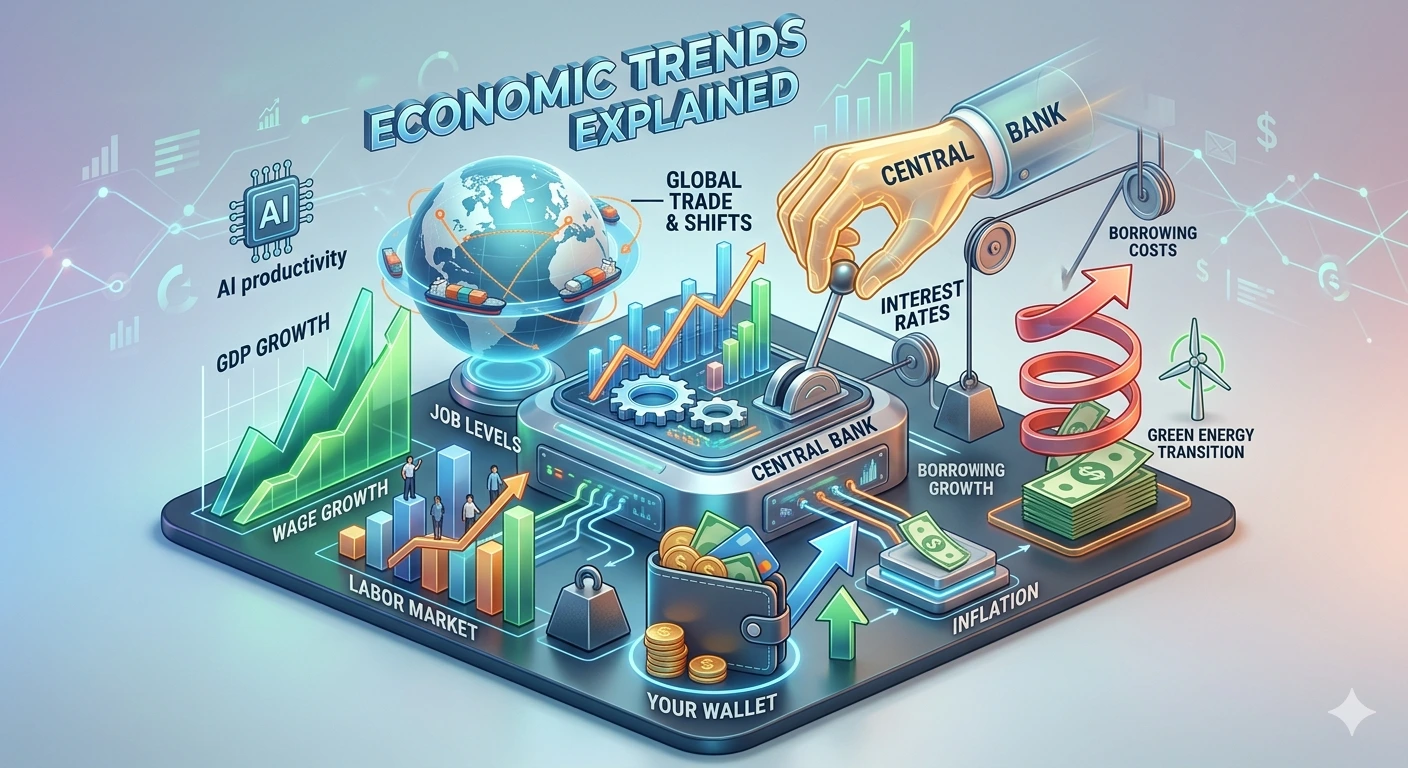
The world economy often feels like a massive, churning ocean. To the untrained eye, it’s just a chaotic mess of waves and white noise. But to the savvy navigator, those waves are actually predictable currents—economic trends that dictate whether your savings will grow, whether your job is secure, and whether that dream home is within reach.
Most people ignore economic news because it sounds like a different language. “Basis points,” “quantitative easing,” and “inverted yield curves” are enough to make anyone tune out. However, ignoring the economy is like trying to sail a boat without looking at the weather forecast. You might stay afloat for a while, but eventually, a storm you didn’t see coming will capsize your progress.
This guide is your compass. We are going to strip away the jargon and explain economic trends in a way that actually makes sense for your life and your bank account. By the end of this deep dive, you won’t just be watching the news; you’ll be predicting how it affects your future.
Table of Contents
- The Foundation: What Are Economic Trends?
- GDP: Measuring the Heartbeat of Nations
- Inflation: The Silent Thief of Purchasing Power
- Interest Rates: The Puppet Masters of the Market
- The Labor Market: Jobs, Wages, and Participation
- Fiscal vs. Monetary Policy: Who Is in Control?
- Global Trade and Supply Chains
- Emerging Trends: AI, Green Energy, and the Future
- How to Apply Economic Trends to Your Personal Finances
- FAQs
- Summary
1. The Foundation: What Are Economic Trends?
At its simplest, an economic trend is the general direction in which an economy is moving. These trends are not “blips” or daily fluctuations in the stock market; they are long-term shifts in data that indicate the health and trajectory of a country or the global community.
Why Do They Matter to You?
Every major financial decision you make is tethered to an economic trend.
- Buying a house? You are at the mercy of interest rate trends.
- Asking for a raise? You are negotiating against inflation and labor market trends.
- Investing in stocks? You are betting on GDP growth and corporate earnings trends.
Understanding these patterns allows you to move from a reactive financial state (complaining about prices when they go up) to a proactive one (adjusting your portfolio before prices spike).
2. GDP: Measuring the Heartbeat of Nations
Gross Domestic Product (GDP) is the “granddaddy” of economic indicators. It represents the total dollar value of all goods and services produced within a country’s borders over a specific time period.
The Two Faces of GDP
To understand GDP trends, you must distinguish between Nominal and Real GDP:
| Feature | Nominal GDP | Real GDP |
| Definition | Value of goods/services at current market prices. | Value of goods/services adjusted for inflation. |
| Best For | Comparing the size of different economies today. | Measuring actual economic growth over time. |
| The “Catch” | Can look high just because prices went up (inflation). | Provides the “true” picture of productivity. |
The GDP Cycle: Boom and Bust
Economies don’t grow in a straight line. They move in cycles:
- Expansion: GDP is growing, jobs are plentiful, and consumer confidence is high.
- Peak: The highest point of growth before things start to cool down.
- Contraction (Recession): GDP shrinks for two consecutive quarters. Unemployment usually rises.
- Trough: The bottom of the cycle before growth begins again.
Pro Tip: As an individual, you want to build your “cash cushions” during the expansion phase so you can buy assets (like stocks or real estate) at a discount during the trough.
3. Inflation: The Silent Thief of Purchasing Power
If you feel like $100 doesn’t buy what it used to, you are experiencing the primary economic trend of our era: Inflation.
Inflation is the rate at which the general level of prices for goods and services is rising. While a small amount of inflation (around 2%) is considered healthy for a growing economy, high inflation erodes your savings like rust on a car.
The Causes of Inflation
- Demand-Pull Inflation: When consumers have too much money and want to buy more goods than businesses can produce (“Too much money chasing too few goods”).
- Cost-Push Inflation: When the cost of production (like oil or wages) goes up, and businesses pass those costs to you.
- Monetary Expansion: When the government prints too much money, devaluing the currency already in circulation.
How to Protect Yourself
When inflation trends are high, “Cash is Trash.” Your money sitting in a standard savings account loses value every day. To combat this, investors typically look toward inflation-protected assets like:
- Real Estate (Rents usually rise with inflation).
- Commodities (Gold, Oil, Wheat).
- Treasury Inflation-Protected Securities (TIPS).
4. Interest Rates: The Puppet Masters of the Market
If GDP is the heartbeat and inflation is the temperature, Interest Rates are the medicine used to keep the patient stable. In the United States, the Federal Reserve (The Fed) sets the benchmark interest rate.
The Seesaw Effect
Interest rates and the economy have a “seesaw” relationship:
- When the economy is slow: The Fed lowers interest rates. This makes it cheap to borrow money, encouraging people to buy houses and businesses to expand.
- When the economy is overheating (high inflation): The Fed raises interest rates. This makes borrowing expensive, cooling down spending and bringing prices back down.
The Impact on Your Wallet
| Financial Product | When Rates Rise | When Rates Fall |
| Savings Accounts | You earn more interest (Good). | You earn less interest (Bad). |
| Mortgages | Monthly payments increase (Bad). | Refinancing becomes attractive (Good). |
| Stock Market | Usually drops (Borrowing costs hurt profits). | Usually rises (Cheap money fuels growth). |
5. The Labor Market: Jobs, Wages, and Participation
You cannot explain economic trends without looking at how people earn their living. The labor market is a “lagging indicator,” meaning it usually changes after the rest of the economy has already started shifting.
Key Metrics to Watch
- Unemployment Rate: The percentage of people actively looking for work who cannot find it.
- Wage Growth: Are salaries keeping up with inflation? If inflation is 5% and your raise is 3%, you actually took a 2% pay cut.
- Labor Force Participation: The percentage of the population that is either working or looking for work. This helps identify “hidden” economic struggles, like people giving up on finding jobs entirely.
The “Great Reshuffle”
Modern trends show a shift toward Remote Work and the Gig Economy. This isn’t just a lifestyle choice; it’s an economic shift that affects commercial real estate (fewer offices needed) and urban tax bases.
6. Fiscal vs. Monetary Policy: Who Is in Control?
When the economy hits a rough patch, two different groups pull two different levers. Understanding who is doing what helps you predict future market moves.
Comparison Table: Monetary vs. Fiscal Policy
| Feature | Monetary Policy | Fiscal Policy |
| Controlled By | Central Banks (The Fed, ECB). | The Government (Congress/Parliament). |
| Tools | Interest Rates, Money Supply. | Taxes, Government Spending. |
| Goal | Price stability and low unemployment. | Economic growth and social priorities. |
| Speed | Can be changed quickly. | Very slow (requires political debate). |
When the government spends trillions on infrastructure (Fiscal) while the Fed raises rates (Monetary), they are essentially stepping on the gas and the brakes at the same time. This creates volatility—and opportunity for the educated investor.
7. Global Trade and Supply Chains
We no longer live in isolated economies. A drought in Taiwan can lead to a shortage of computer chips in Detroit, which raises the price of used cars in London.
The Trend of “Deglobalization”
For decades, the trend was “Offshoring”—moving production to wherever it was cheapest. Recently, we’ve seen a shift toward “Friend-shoring” or “Onshoring.” * Why? Countries realized that relying on a single distant country for essential goods (like medicine or microchips) is a massive national security risk.
- The Result: Prices may go up (since domestic labor is more expensive), but supply chains become more resilient.
8. Emerging Trends: AI, Green Energy, and the Future
If you want to build wealth, you have to look at where the puck is going, not where it is.
Artificial Intelligence (AI) and Productivity
Economists are watching AI closely because it has the potential to trigger a Productivity Boom. Historically, when technology makes workers more efficient (like the steam engine or the internet), GDP skyrockets and new industries are born. However, the short-term trend may involve significant job displacement in service sectors.
The Green Transition
The shift from fossil fuels to renewable energy is one of the largest capital migrations in human history. Trillions of dollars are moving into:
- Electric Vehicle (EV) infrastructure.
- Carbon capture technology.
- Battery storage.
Investors who align their “wealth mindset” with these inevitable shifts are often the ones who see the highest long-term returns.
9. How to Apply Economic Trends to Your Personal Finances
Knowing the facts is useless if you don’t act on them. Here is how to use economic trends to win:
- In High Inflation: Focus on “Hard Assets.” Don’t let your emergency fund grow too large beyond what you need; put the excess into investments that outpace inflation.
- In High Interest Rate Environments: Pay off high-interest debt (like credit cards) immediately. Avoid taking out new variable-rate loans.
- During a Recession: Prioritize job security and liquidity. This is the time to have a “recession-proof” side hustle and extra cash to buy stocks when they are “on sale.”
- In a Growth Phase: This is the time to take calculated risks. Start that business, invest in growth stocks, and expand your professional skills.
Learn More About Financial Growth
Understanding economic trends is key to making smart financial decisions. Enhance your knowledge by learning financial literacy basics, preparing for the future with retirement planning strategies, and applying insights to your long-term financial planning goals.
10. Frequently Asked Questions (FAQs)
1. What is the most important economic indicator for a regular person?
The Consumer Price Index (CPI). It measures inflation and tells you exactly how much more expensive daily life is becoming.
2. Does a stock market crash mean a recession is coming?
Not always. As the saying goes, “The stock market has predicted nine of the last five recessions.” The market is based on expectations, while a recession is based on actual production.
3. Why does the government want 2% inflation? Why not 0%?
Zero inflation (or deflation) encourages people to stop spending. If you knew a TV would be cheaper next month, you’d wait to buy it. This stops the economy. 2% inflation encourages steady spending and investment.
4. How do interest rates affect my small business?
Higher rates make business loans more expensive, which can limit your ability to buy equipment or hire new staff.
5. What is a “Soft Landing”?
This is when a Central Bank raises interest rates just enough to stop inflation without causing a full-blown recession. It’s a very difficult balancing act.
6. Is the US Dollar still the global reserve currency?
Yes, though there is significant discussion about “de-dollarization.” Currently, the majority of global trade and central bank reserves are still in USD.
7. How does the “Yield Curve” predict a recession?
When short-term bonds pay more than long-term bonds (an inverted yield curve), it suggests investors are worried about the near future. Historically, this has been a very reliable recession warning.
8. Will AI cause mass unemployment?
While AI will automate many tasks, history shows that technology usually creates more jobs than it destroys—they just happen to be different types of jobs.
9. What happens to my savings if a bank fails?
In many countries, deposits are insured up to a certain limit (like $250,000 per bank in the US via the FDIC). Always ensure your bank is federally insured.
10. How often should I check economic data?
Monthly is plenty. Checking daily can lead to “noise” and emotional decision-making. Focus on the long-term trends.
Summary: Becoming the Master of Your Economic Destiny
Understanding economic trends isn’t about becoming a math genius; it’s about becoming a better observer of the world. When you understand that GDP, inflation, and interest rates are interconnected parts of a giant machine, the “scary” headlines start to look like actionable data.
The most successful people aren’t the ones who work the hardest; they are the ones who work the smartest by aligning their efforts with the direction of the global economy. Don’t let the trends happen to you. Use this knowledge to make the trends work for you.
Your next step: Look up the current inflation rate and the most recent central bank interest rate decision. Once you know those two numbers, you’re already ahead of 90% of the population.